Time and Work Aptitude Guide : Question Types, Solved Examples, Shortcuts & Practice

Time and Work Aptitude Guide: Concepts, Formulas & Unit Work Method
Time and Work is one of the most important topics in quantitative aptitude. Whether you’re preparing for campus placements, banking exams, SSC, Railways, or CAT, you can expect at least one or two questions from this chapter.
The good news is that Time and Work follows a small set of concepts. Once you understand how work rate and efficiency are connected, even lengthy-looking questions become much easier to solve.
In this guide, you’ll learn the fundamentals of Time and Work in a simple, step-by-step manner. We’ll focus on understanding the concepts first before moving to shortcuts and advanced questions.
Quick Answer
Time and Work problems are based on the relationship between work completed, time taken, and efficiency.
Instead of measuring the total work directly, aptitude questions compare how much work a person can complete in one day. Once you know the one-day work of each person, solving combined work problems becomes much easier.
Time and Work Formula Summary
| Formula | Expression |
|---|---|
| Work | Work = Time × Efficiency |
| Time | Time = Work ÷ Efficiency |
| Efficiency | Efficiency = Work ÷ Time |
| One-Day Work | 1 ÷ Total Days |
| Combined Work | Sum of Individual One-Day Works |
Pocket Aptitude Tip: Don’t memorize formulas blindly. First understand the relationship between work, time, and efficiency. The formulas will then become easy to remember.
Why is Time and Work Important in Aptitude Exams?
Time and Work questions test your logical thinking, calculation speed, and understanding of ratios. Since the formulas are straightforward, these questions often become scoring opportunities for candidates who practice regularly.
You’ll frequently encounter Time and Work questions in:
| Exam | Weightage |
|---|---|
| Campus Placements | High |
| CAT | Medium |
| Bank PO | High |
| SSC CGL | High |
| Railway Exams | Medium |
If you’re preparing for competitive exams, mastering this topic can significantly improve both your speed and accuracy.
What is Time and Work?
Time and Work is an aptitude topic that deals with the relationship between the amount of work completed, the time taken, and the efficiency of workers.
Instead of calculating the actual amount of work done, most aptitude questions compare how quickly different people complete the same job. By understanding each person’s work rate, you can solve almost every Time and Work problem with ease.
Example
If Rahul can paint a wall in 10 days and Priya can paint the same wall in 15 days, the question usually asks how long they would take if they worked together.

Basic Concepts of Time and Work
Before learning formulas, let’s understand the four building blocks of this topic.
1. Work
Work simply means the task that needs to be completed.
Examples include:
- Painting a house
- Building a wall
- Typing a document
- Filling a water tank
- Completing a project
In aptitude questions, the actual size of the work usually doesn’t matter. We simply consider it as one complete job.
Example
If a carpenter builds one table, we call that one unit of work.
If two carpenters together complete that same table, the total work is still considered one complete job.
2. Time
Time is the duration required to finish the work.
It can be measured in:
- Days
- Hours
- Minutes
Example
A worker finishes a task in 8 days.
- Work = One complete task
- Time = 8 days
3. Efficiency
Efficiency tells us how fast someone can complete work.
A person who finishes a task earlier is more efficient than someone who takes longer.
Example
Suppose:
- A completes a job in 5 days
- B completes the same job in 10 days
Since A takes less time, A is more efficient than B.
Think of efficiency like speed. A faster worker completes more work in the same amount of time.
4. Work Rate
Work rate means the amount of work completed in one unit of time, usually one day.
Instead of asking:
How many days does a person take?
Aptitude questions often convert it into:
How much work does the person finish in one day?
This approach makes calculations much easier.
Example
If Riya completes a project in 20 days,
Then her one-day work is:
1/20
This idea is called One-Day Work, and it is the foundation of almost every Time and Work problem.
Understanding the Relationship Between Work, Time, and Efficiency
These three quantities are closely connected.
Imagine two workers are asked to paint the same room.
Both have the same amount of work.
One worker paints faster.
Naturally, the faster worker finishes in less time.
This leads to an important rule:
Higher efficiency means less time.
Similarly,
- More work requires more time.
- Higher efficiency requires less time.
- For the same work, efficiency and time are inversely proportional.
Understanding this relationship is much more useful than memorizing formulas.

Time and Work Formulas Explained
Now that we’ve understood the concepts, the formulas become very easy.
Work = Time × Efficiency
Think about cleaning a classroom.
If a student cleans for 3 hours and finishes 2 units of work every hour, then:
Work = Time × Efficiency
More working time or higher efficiency results in more work completed.
Efficiency = Work ÷ Time
Suppose two workers complete the same task.
- Worker A finishes in 5 days.
- Worker B finishes in 10 days.
Since both completed the same work, Worker A is more efficient because the work was completed in less time.
Efficiency measures how much work is completed per unit time.
Time = Work ÷ Efficiency
Imagine a machine that packs 100 boxes every hour.
If you need to pack 500 boxes, the required time depends on how efficiently the machine works.
A more efficient machine finishes sooner.
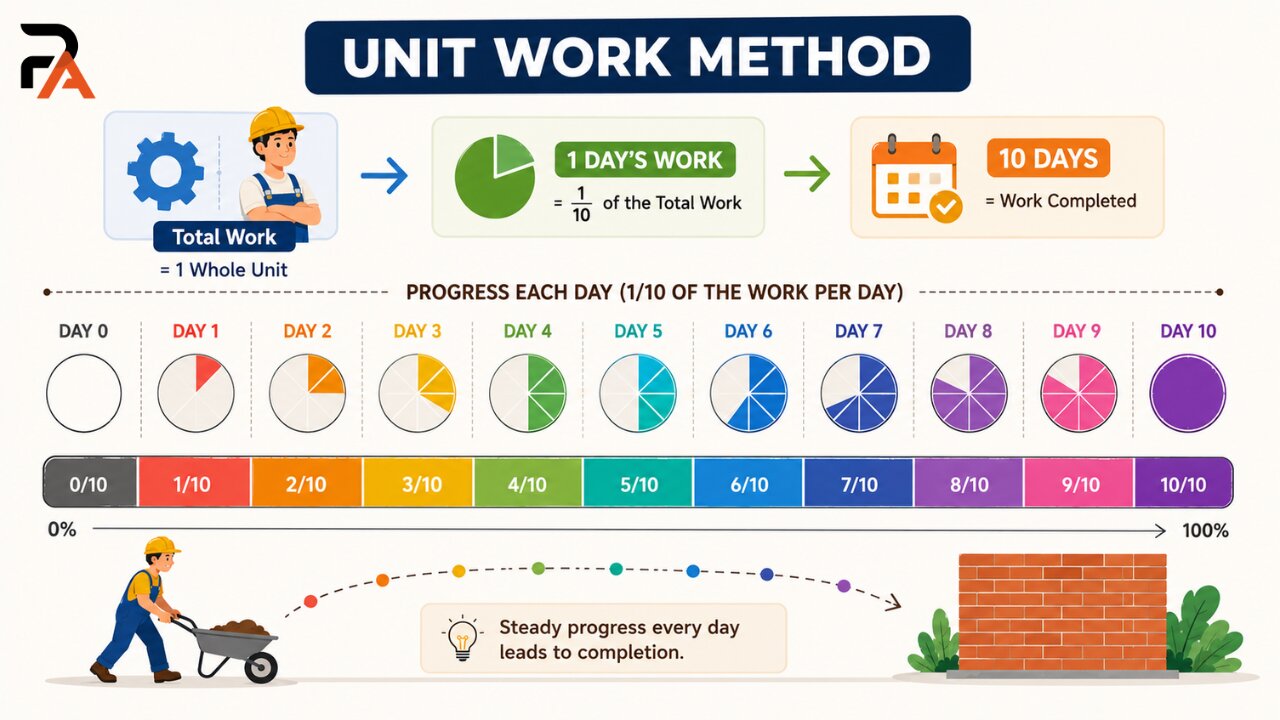
The Unit Work Method (Most Important)
The Unit Work Method is the standard approach used in almost every aptitude exam.
Instead of working with the total number of days directly, convert each person’s work into one-day work.
This makes combined work problems much simpler.
See It in Action
Example
A completes a job in 10 days.
One day’s work = 1/10
B completes the same job in 15 days.
One day’s work = 1/15
Together,
One day’s work
= 1/10 + 1/15
LCM = 30
= 3/30 + 2/30
= 5/30
= 1/6
Therefore,
they complete the work in 6 days.
Why Does This Method Work?
Think of each worker as contributing a small portion of the work every day.
Instead of asking:
How many days will they take?
First ask:
How much work do they complete in one day?
Once you know the combined one-day work, finding the total time becomes straightforward.
This is why almost every Time and Work question begins by calculating one-day work.
How to Solve Any Time and Work Question
Follow these six simple steps:
- Read the question carefully.
- Convert each worker’s time into one-day work.
- Add or subtract work rates as required.
- Calculate the combined one-day work.
- Take the reciprocal to find the required time.
- Verify your answer before moving on.
Pocket Aptitude Tip 💡
Always convert people into one-day work before solving the problem.
This method works for nearly every Time and Work question, including:
- One person
- Multiple workers
- Alternate-day work
- Workers joining or leaving
- Efficiency comparison
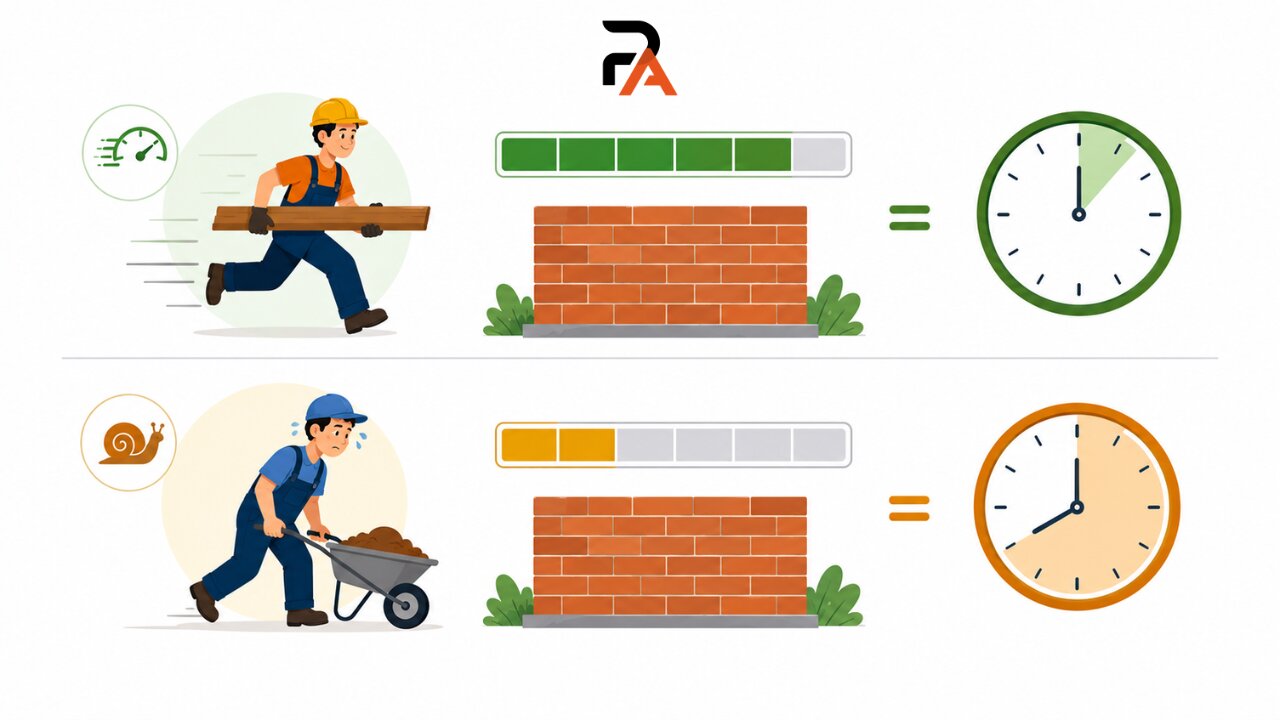
Relationship Between Efficiency and Time
Efficiency and time are inversely proportional.
This means:
- If efficiency increases, time decreases.
- If efficiency decreases, time increases.
- Efficiency × Time remains constant for the same amount of work.
| Efficiency | Time Taken |
|---|---|
| Double | Half |
| Triple | One-third |
| Half | Double |
| Four Times | One-fourth |
Example
Rahul completes a task in 12 days.
Another worker is twice as efficient.
Since efficiency doubles, the required time becomes half.
Therefore,
Time = 6 days
Similarly,
If a worker is only half as efficient,
Time = 24 days
Remember this inverse relationship because it appears frequently in aptitude questions.
Think Like an Interviewer
Interviewers don’t ask Time and Work questions to test whether you remember formulas.
They want to know whether you understand work rates.
Many candidates lose marks because they add days instead of one-day work.
If you always convert workers into one-day work first, you’ll solve most questions correctly.
What’s Next?
Now that you’ve learned the concepts, formulas, and the Unit Work Method, you’re ready for Part 2, where we’ll cover:
- Common Question Types
- Solved Examples
- Shortcut Tricks
- Common Mistakes
- Practice Questions
- FAQs
These topics will help you solve placement-level and competitive exam questions confidently.
Related Articles
Summary
Before moving to advanced questions, make sure you understand these key points:
- Work = Time × Efficiency
- One-Day Work = 1 ÷ Total Days
- Always add work rates, not days.
- Efficiency and time are inversely proportional.
- The Unit Work Method is the most reliable approach for solving Time and Work questions.
Once these concepts are clear, solving Time and Work questions becomes much faster and easier.
Common Types of Time and Work Questions
Different competitive exams ask Time and Work questions in different formats. Once you identify the question type, choosing the right approach becomes much easier.
1One Person Working Alone
The simplest kind. You're given the time one person takes, and you find the one-day work or the time for a different amount of work.
2Two Persons Working Together
Add the one-day work of both people to find how long they take as a team.
3Men and Women Working Together
Men and women often work at different efficiencies. Convert everyone into equal efficiency units before adding.
4Men, Women and Children
These give ratios like 2 Men = 3 Women and 3 Women = 4 Children. Convert everyone into one common unit first.
5Alternate Day Working
Workers take turns instead of working together every day. Find the work done over one full cycle, then the remainder.
6Work Left After Some Days
One worker leaves before the job is done. Find the work already completed, subtract it from 1, and solve the rest.
7Efficiency Comparison
These compare workers by efficiency instead of days. Higher efficiency always means less time — use inverse proportion.
Solved Examples
Can You Guess?
Before you calculate, take a guess. Pick an option for each question below to reveal the full solution — your score tallies up as you go.
A completes a job in 20 days. How much work does A complete in one day?
🤔 Without calculating, what do you think?
👇 Pick an option to see the answer
B completes a job in 25 days. How many days will B take to complete half the work?
🤔 Without calculating, what do you think?
👇 Pick an option to see the answer
A completes a job in 12 days. B completes it in 18 days. How many days will they take together?
🤔 Without calculating, what do you think?
👇 Pick an option to see the answer
A is twice as efficient as B. If B finishes a task in 16 days, how long will A take?
🤔 Without calculating, what do you think?
👇 Pick an option to see the answer
A can complete a task in 15 days. After working alone for 5 days, B joins. Together they finish the remaining work in 6 days. Find the time taken by B alone.
🤔 Without calculating, what do you think?
👇 Pick an option to see the answer
Shortcut Tricks
1. LCM Method
Assume the total work is the LCM of the given completion days.
Example
A = 12 days
B = 18 days

LCM = 36 units

A's efficiency = 3 units/day
B's efficiency = 2 units/day

Together = 5 units/day

Time = 36 ÷ 5 = 7.2 days
Use when: The question provides completion times.
2. Efficiency Ratio Shortcut
If:
A : B = 3 : 2Their work rates are already known.
No need to calculate fractions separately.
Use when: Efficiency ratios are directly given.
3. Percentage Efficiency Shortcut
If A is 25% more efficient than B:
Efficiency Ratio
= 125 : 100
= 5 : 4

Time Ratio
= 4 : 5
This avoids lengthy calculations.
When NOT to Use Shortcuts
Avoid shortcuts when:
- Multiple workers join or leave.
- Alternate-day working is involved.
- Work is completed in different stages.
- The question contains changing efficiencies.
In these cases, the One-Day Work Method is more reliable.
Common Mistakes
- Adding days instead of work rates.
- Forgetting to convert into one-day work.
- Mixing efficiency with time.
- Ignoring inverse proportionality.
- Using the wrong LCM.
- Applying shortcuts without understanding the question.
Practice Questions
- A completes a task in 18 days. Find A’s one-day work.
- B completes a task in 30 days. How long will B take to complete half the work?
- A finishes a job in 12 days and B in 20 days. Find the time taken together.
- A is twice as efficient as B. If B takes 24 days, how many days does A take?
- A and B together complete a job in 8 days. A alone takes 24 days. Find B’s time.
- A works alone for 6 days and completes half the work. How many days are needed to finish the remaining work?
- A, B, and C complete a task in 10, 15, and 30 days respectively. How long will they take together?
- A is 50% more efficient than B. If B takes 18 days, how long does A take?
- A and B together work for 4 days and complete half the task. Find the total time required together.
- A can complete a task in 20 days. After working for 8 days, B joins and together they finish the remaining work in 6 days. Find B’s time alone.
Frequently Asked Questions
What is the easiest way to solve Time and Work questions?
The easiest and most reliable method is the One-Day Work Method.
What is one day’s work?
One day’s work is the fraction of the total work completed in one day.
How do you calculate efficiency?
Efficiency is calculated by dividing work by time.
Why do we use LCM in Time and Work?
The LCM makes adding work-rate fractions easier.
Is Time and Work important for placements?
Yes. It is frequently asked in placements, SSC, Banking, Railways, CAT, and many competitive exams.
Are Time and Work and Pipes & Cisterns related?
Yes. Both topics are based on the concept of work rate.
Which exams ask Time and Work questions?
- SSC
- Banking
- Railways
- CAT
- State PSC
- Insurance Exams
- Campus Placements
Related Articles
- Percentage
- Ratio and Proportion
- Average
- Time, Speed and Distance
- Pipes and Cisterns
- Partnership (Coming Soon)
Conclusion
Time and Work is one of the highest-scoring topics in quantitative aptitude because it relies on a few core concepts rather than complex mathematics. By mastering the One-Day Work Method, understanding the inverse relationship between efficiency and time, and practising a variety of question types, you’ll be well prepared for placements and competitive exams.
Start with the fundamentals, avoid common mistakes, and use shortcuts only when appropriate. With consistent practice, Time and Work can become one of your strongest aptitude topics.