Pipes and Cisterns Aptitude Guide: Concepts, Formulas & Unit Filling Method

Pipes and Cisterns is one of the most frequently asked topics in quantitative aptitude. It appears in campus placements, SSC, Banking, Railways, CAT, and many other competitive exams.
Although it may look like a completely new topic, it is actually based on the same principle as Time and Work. Instead of workers completing a job, pipes fill or empty a water tank.
Once you understand the concept of rate, solving Pipes and Cisterns questions becomes much easier.
Quick Answer
Pipes and Cisterns problems calculate how quickly one or more pipes can fill or empty a tank.
Instead of measuring the total amount of water, aptitude questions calculate how much of the tank is filled or emptied in one hour. Once you know each pipe’s one-hour filling rate, solving combined pipe questions becomes straightforward.
Formula Summary
| Formula | Expression |
|---|---|
| Filling Rate | 1 ÷ Filling Time |
| Emptying Rate | −1 ÷ Emptying Time |
| Combined Rate | Sum of Individual Rates |
| Time Required | 1 ÷ Combined Rate |
💡 Pocket Aptitude Tip
Treat every pipe as a worker.
A worker completes work.
A pipe fills water.
The mathematical concept remains exactly the same.
Why Learn Pipes and Cisterns?
Pipes and Cisterns is considered one of the highest-scoring aptitude topics because every question follows a logical pattern.
You’ll frequently encounter questions from this topic in:
| Exam | Importance |
|---|---|
| Campus Placements | ⭐⭐⭐⭐☆ |
| SSC | ⭐⭐⭐⭐⭐ |
| Banking | ⭐⭐⭐⭐⭐ |
| Railways | ⭐⭐⭐⭐☆ |
| CAT | ⭐⭐⭐☆☆ |
If you’ve already learned Time and Work, you’ll find this topic much easier because both share the same underlying concept.
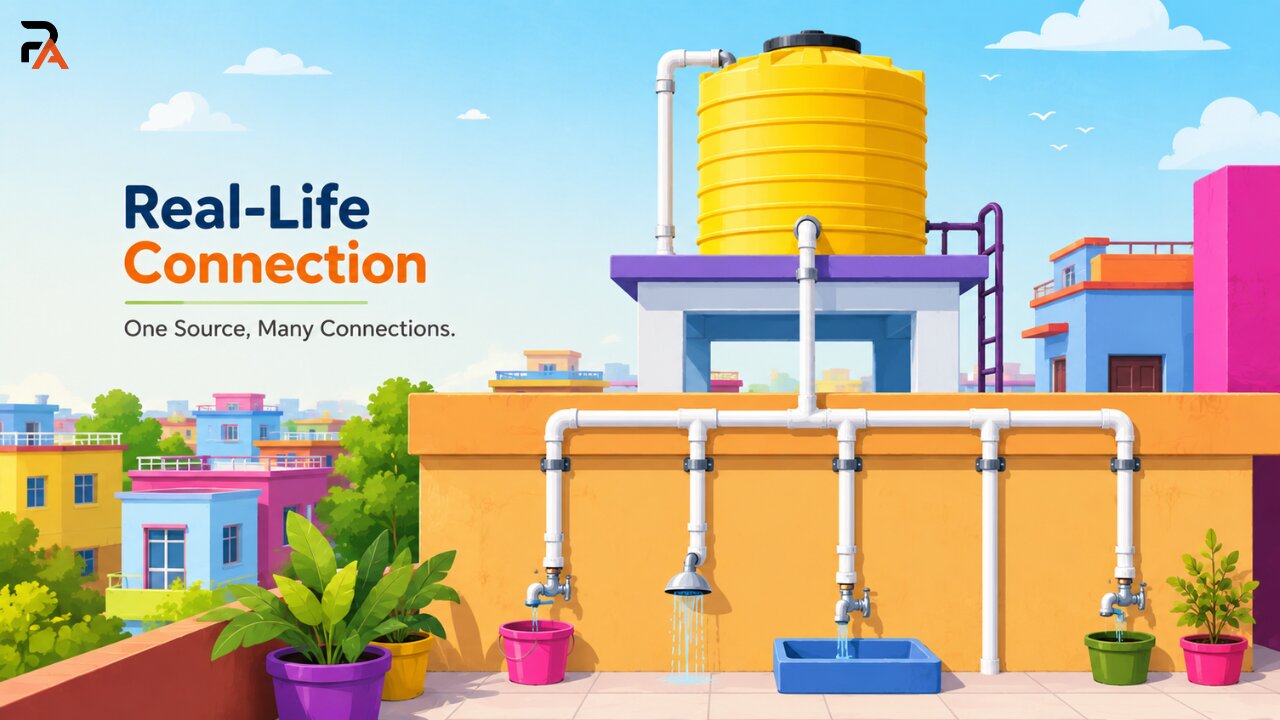
Real-Life Connection
Imagine the overhead water tank in your apartment.
Every morning:
- One pipe fills the tank.
- Another pipe may drain water.
- Sometimes a small leak slowly empties the tank.
The question naturally becomes:
How long will it take for the tank to become completely full?
This is exactly what Pipes and Cisterns questions ask in aptitude exams.
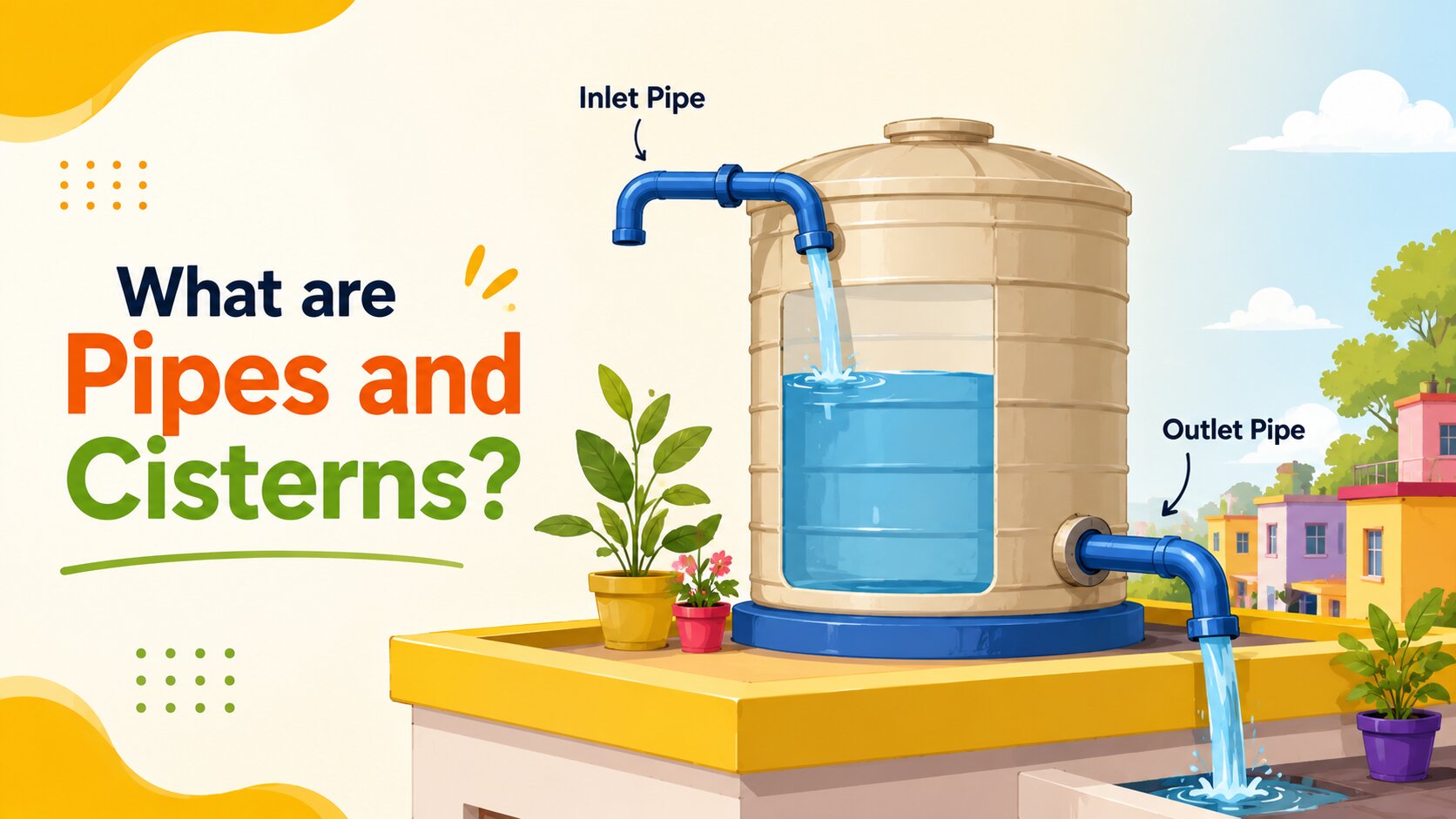
What are Pipes and Cisterns?
Pipes and Cisterns is an aptitude topic that studies the rate at which pipes fill or empty a tank.
Instead of workers completing work,
pipes perform the work.
Instead of completing a job,
they fill or empty water.
The mathematical idea is identical to Time and Work.
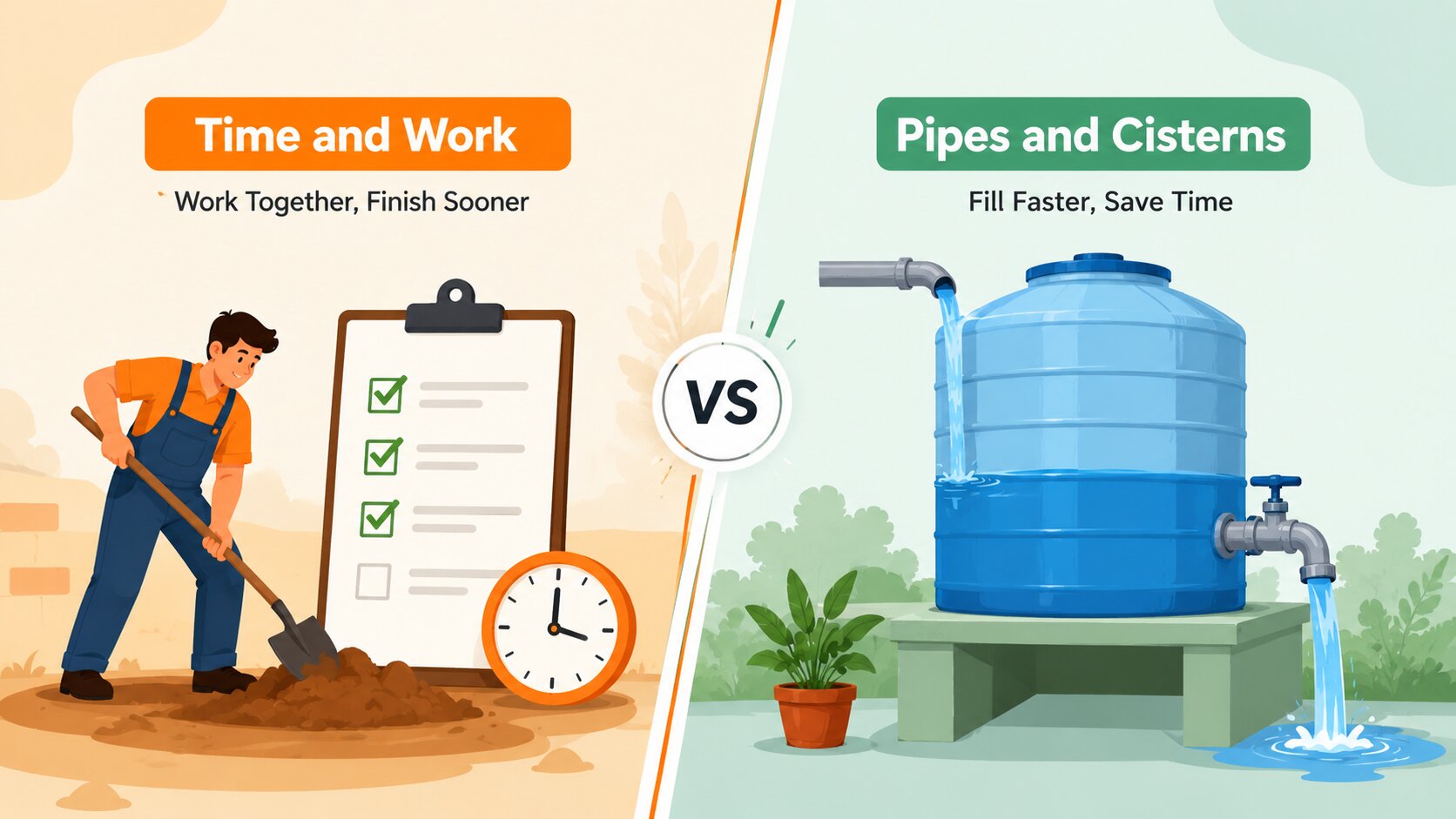
Time and Work vs Pipes and Cisterns
Many students think these are two different topics.
In reality, the mathematics behind them is exactly the same.
| Time and Work | Pipes and Cisterns |
|---|---|
| Worker | Pipe |
| Work | Water |
| Job | Tank |
| One-Day Work | One-Hour Filling |
| Combined Work | Combined Filling Rate |
Pocket Aptitude Insight
If you understand One-Day Work, you’re already halfway to mastering Pipes and Cisterns.
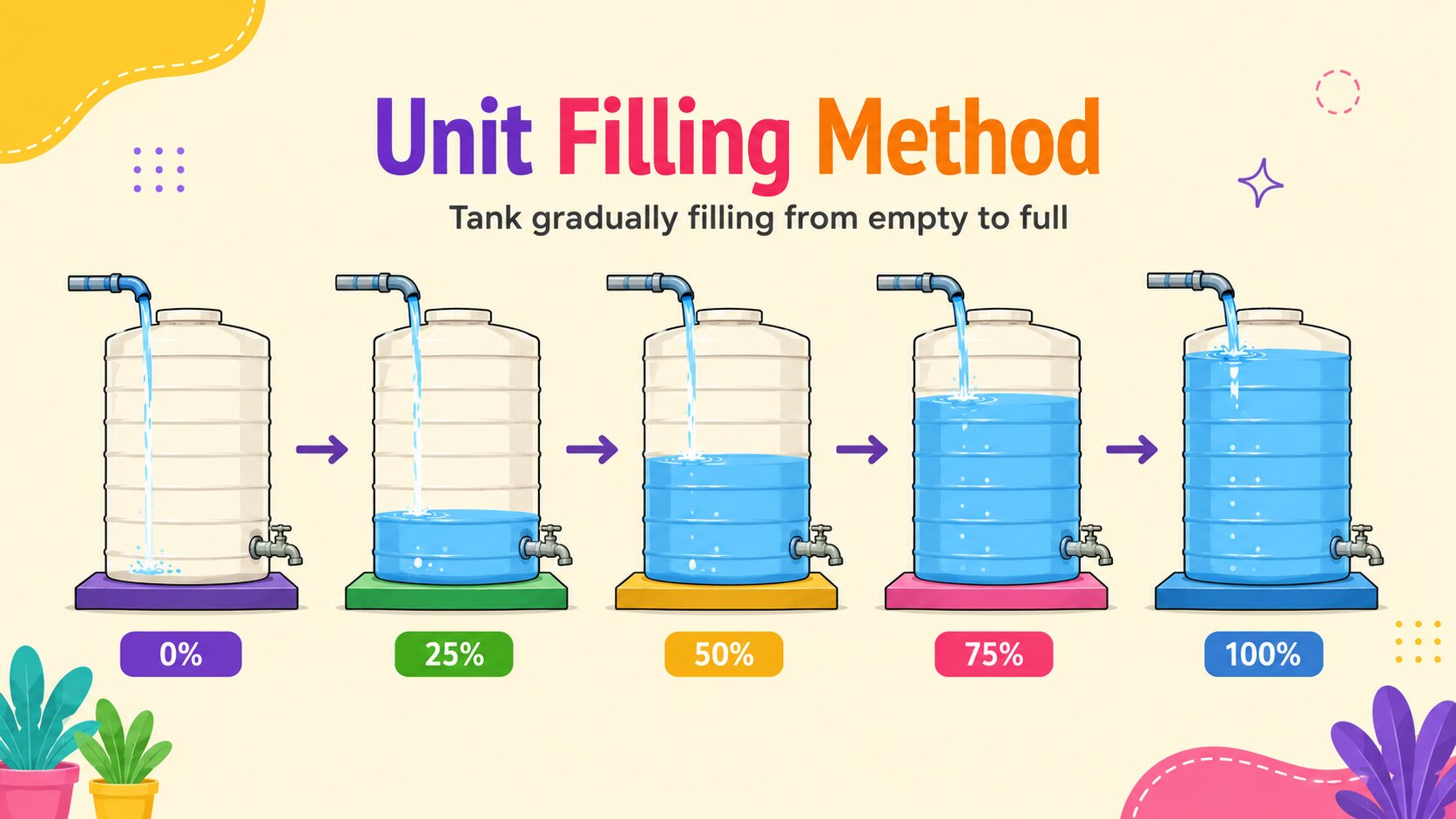
Basic Concepts
Before solving questions, let’s understand the key terms.
1. Cistern (Tank)
A cistern is simply a container that stores water.
Examples include:
- Overhead water tank
- Underground tank
- Swimming pool
- Storage reservoir
In aptitude problems, the tank is usually considered one complete unit.
2. Inlet Pipe
An inlet pipe adds water to the tank.
Every hour, the amount of water inside the tank increases.
Example
If Pipe A fills a tank in 12 hours,
then every hour it fills:
1/12 of the tank.
3. Outlet Pipe
An outlet pipe removes water from the tank.
Instead of increasing the water level, it decreases it.
Example
If an outlet pipe empties a full tank in 15 hours,
then every hour it removes:
1/15 of the tank.
4. Leak
A leak behaves exactly like an outlet pipe.
Although it usually removes water more slowly, its effect is the same.
Whenever a leak appears in a question,
its rate is treated as negative.
5. Filling Rate
The filling rate tells us how much of the tank is filled every hour.
If a pipe fills a tank in 20 hours,
then:
One-Hour Filling = 1/20
This is the foundation of every Pipes and Cisterns problem.
Visualize the Concept
Imagine a pipe filling a water tank. Drag the slider and watch it happen, hour by hour.
Instead of thinking:
“It fills the tank in 10 hours.”
Think:
“Every hour, it fills 1/10 of the tank.”
That’s exactly why aptitude questions use the One-Hour Filling Method.
Understanding Filling Rate and Time
Imagine two pipes.
Pipe A fills the tank in 8 hours.
Pipe B fills the same tank in 16 hours.
Which pipe is faster?
Obviously,
Pipe A.
This gives us an important rule:
Higher filling rate means less time.
Similarly:
- Faster pipe → Less time
- Slower pipe → More time
- Filling rate and time are inversely proportional
| Filling Rate | Time Taken |
|---|---|
| Double | Half |
| Triple | One-third |
| Half | Double |
| Four Times | One-fourth |
Pipes and Cisterns Formulas Explained
Instead of memorizing formulas, understand why they work.
Filling Rate
If a pipe fills an entire tank in 10 hours,
then every hour it fills:
1/10
of the tank.
Emptying Rate
If another pipe empties the same tank in 20 hours,
then every hour it removes:
1/20
of the tank.
Since water is leaving the tank,
this rate is considered negative.
Combined Rate
If two inlet pipes work together,
their filling rates are added.
If one inlet pipe and one outlet pipe work together,
subtract the outlet rate from the inlet rate.
This single concept solves most Pipes and Cisterns questions.
The Unit Filling Method (Most Important)
The Unit Filling Method is the standard approach used in aptitude exams.
Instead of working with the total number of hours,
convert every pipe into One-Hour Filling.
Example
Pipe A fills a tank in 10 hours.
One-Hour Filling
= 1/10
Pipe B fills the same tank in 15 hours.
One-Hour Filling
= 1/15
Combined Filling Rate
= 1/10 + 1/15
LCM = 30
= 3/30 + 2/30
= 5/30
= 1/6
Therefore,
both pipes together fill the tank in:
6 hours
Why Does This Method Work?
Think of each pipe as filling a small portion of the tank every hour.
Instead of asking:
“How many hours will it take?”
First ask:
“How much of the tank is filled in one hour?”
Once you know the combined filling rate,
finding the total time becomes very simple.
How to Solve Any Pipes and Cisterns Question
Follow these six steps:
- Read the question carefully.
- Convert every pipe into One-Hour Filling.
- Add all inlet pipe rates.
- Subtract outlet or leak rates.
- Calculate the combined filling rate.
- Take the reciprocal to find the required time.
💡 Pocket Aptitude Tip
Don’t calculate using hours directly.
Always convert every pipe into One-Hour Filling first.
This method works for:
- One inlet pipe
- Multiple inlet pipes
- Outlet pipes
- Leak problems
- Pipes opened or closed later
Think Like an Interviewer
Interviewers don’t test whether you remember formulas.
They test whether you understand rates.
Many candidates make mistakes because they:
- Add hours instead of rates.
- Forget that outlet pipes remove water.
- Ignore leaks.
If you always calculate One-Hour Filling first, you’ll solve most questions correctly.
Common Beginner Mistakes
❌ Adding the hours taken by different pipes.
✅ Add the rates, not the hours.
❌ Forgetting that an outlet pipe has a negative rate.
✅ Always subtract the outlet or leak rate.
❌ Solving directly without converting to One-Hour Filling.
✅ Convert every pipe into a one-hour rate first.
Before You Start Solving
Before attempting any question, remember these four rules:
✅ Convert every pipe into One-Hour Filling
✅ Add all inlet pipe rates
✅ Subtract outlet or leak rates
✅ Take the reciprocal to find the required time
💡 Pocket Aptitude Tip
Never calculate using hours directly. Always work with rates.
Question Type 1: Single Inlet Pipe
These are the easiest Pipes and Cisterns questions.
Only one pipe is filling the tank.
Example 1 (Easy)
📌 Problem
Pipe A fills a tank in 18 hours.
How much of the tank does it fill in one hour?
💡 Think First
If the entire tank takes 18 hours,
how much is filled in one hour?
Solution
One-Hour Filling
= 1 ÷ 18
= 1/18
⚡ Pocket Aptitude Tip
Whenever a question says:
“Pipe fills a tank in X hours”
immediately convert it into:
1/X
🎯 Final Answer
1/18
Example 2 (Easy)
Pipe B fills a tank in 24 hours.
How much of the tank will it fill in 6 hours?
(Solution omitted for self-practice.)
Question Type 2: Two Inlet Pipes
Both pipes fill the tank together.
Example 3 (Moderate)
📌 Problem
Pipe A fills a tank in 12 hours.
Pipe B fills it in 18 hours.
How long will they take together?
💡 Think First
Don’t add the hours.
Add the filling rates.
Solution
A’s rate = 1/12
B’s rate = 1/18
Combined rate
= 1/12 + 1/18
LCM = 36
= 3/36 + 2/36
= 5/36
Time
= 36/5
= 7.2 hours
🎯 Final Answer
7.2 hours
Question Type 3: Inlet and Outlet Pipe
One pipe fills.
Another empties.
Example 4 (Moderate)
📌 Problem
Pipe A fills a tank in 8 hours.
Pipe B empties it in 24 hours.
How long will it take to fill the tank if both pipes are opened together?
💡 Think First
The outlet pipe slows down the filling process.
Solution
Filling rate
= 1/8
Emptying rate
= 1/24
Combined rate
= 1/8 − 1/24
= 3/24 − 1/24
= 2/24
= 1/12
Time
= 12 hours
🎯 Final Answer
12 hours
Question Type 4: Leak Problems
A leak behaves exactly like an outlet pipe.
Example 5 (Placement Level)
A pipe fills a tank in 10 hours.
A leak empties it in 30 hours.
How long will the tank take to fill?
(Try solving before checking the answer.)
Show Solution
Combined rate
= 1/10 − 1/30
= 3/30 − 1/30
= 2/30
= 1/15
Time
= 15 hours
Question Type 5: Pipe Starts Later
Example 6 (Placement Level)
Pipe A fills a tank in 12 hours.
After working alone for 3 hours, Pipe B is opened.
Pipe B alone can fill the tank in 18 hours.
Find the total time required to fill the tank.
Question Type 6: Pipe Closed Before Completion
Example 7 (Bank Level)
Pipe A and Pipe B start together.
After 4 hours, Pipe B is closed.
Pipe A completes the remaining work.
Find the total time taken.
Question Type 7: Alternate Pipe Operation
Example 8 (SSC Level)
Pipe A works during odd hours.
Pipe B works during even hours.
Find the total time required to fill the tank.
Shortcut Tricks
Trick 1: Convert to One-Hour Filling
Never solve directly using hours.
Convert every pipe into its one-hour filling rate first.
Trick 2: Remember Outlet = Negative
Always subtract the outlet or leak rate.
Trick 3: Use LCM Early
Find the LCM first to simplify fraction calculations.
Trick 4: Estimate the Answer
Before calculating,
ask yourself:
Will the answer be greater than the fastest pipe’s time?
If not,
you’ve probably made a mistake.
Trick 5: Simplify Fractions
Reduce fractions whenever possible.
This saves valuable exam time.
When NOT to Use Shortcuts
Shortcuts work well for simple questions.
However,
for questions involving:
- Pipes opening later
- Pipes closing midway
- Alternate operation
- Multiple leaks
always solve step by step.
Common Mistakes
❌ Adding hours instead of rates.
❌ Forgetting that outlet pipes have a negative rate.
❌ Taking the reciprocal too early.
❌ Ignoring the work completed before another pipe joins.
❌ Wrong LCM calculation.
Speed Improvement Tips
- Memorize reciprocals of common numbers.
- Learn LCM values from 2 to 30.
- Simplify fractions mentally.
- Estimate the answer before calculating.
- Practice at least 10 questions every day.
Practice Questions
Level 1 (Easy)
-
A pipe fills a tank in 16 hours. Find its one-hour filling rate.
-
Pipe A fills a tank in 20 hours. How much water is filled in 5 hours?
-
Pipe B fills a tank in 30 hours. Find the remaining work after 12 hours.
Level 2 (Moderate)
- Pipe A fills in 12 hours.
Pipe B fills in 18 hours.
Find the total filling time.
- Pipe A fills in 8 hours.
Pipe B empties in 24 hours.
Find the total time.
Level 3 (Placement)
- Pipe A starts first.
Pipe B joins after 2 hours.
Find the total time.
- Pipe A fills in 10 hours.
A leak empties in 40 hours.
Find the total time.
Level 4 (SSC & Banking)
-
Three inlet pipes work together.
-
Two inlet pipes and one outlet pipe operate simultaneously.
-
Alternate-hour pipe operation problem.
Mini Mock Test
⏱ Time: 10 Minutes
Questions: 10
Difficulty:
- Easy
- Moderate
- Placement
Try solving without using a calculator.
Challenge Yourself
Can you solve these questions within 60 seconds each?
- Two pipes with different starting times.
- Tank with one inlet and two outlets.
- Leak starts after half the tank is filled.
- Three inlet pipes with one closed midway.
- Alternate-hour filling problem.
Formula Revision Sheet
| Concept | Formula |
|---|---|
| Filling Rate | 1 ÷ Time |
| Emptying Rate | −1 ÷ Time |
| Combined Rate | Sum of Rates |
| Required Time | 1 ÷ Combined Rate |
Exam Tips
Campus Placements
Focus on:
- Two-pipe questions
- Pipes joining later
SSC
Practice:
- Leak problems
- Alternate pipe questions
Banking
Improve:
- Fraction calculations
- Speed and accuracy
CAT
Focus on:
- Multi-step logical questions
- Combined rate problems
Frequently Asked Questions
Is Pipes and Cisterns difficult?
No. Once you understand One-Hour Filling, most questions follow the same pattern.
Why is the outlet pipe negative?
Because it removes water from the tank instead of adding it.
What is the fastest way to solve Pipes and Cisterns questions?
Convert every pipe into its One-Hour Filling rate before starting any calculation.
Which exams ask Pipes and Cisterns questions?
Campus Placements, SSC, Banking, Railways, CAT, and many state-level competitive exams.
Related Articles
- Time and Work
- Percentage
- Ratio and Proportion
- Partnership (Coming Soon)
- Mixture and Alligation (Coming Soon)
Summary
In this guide, you practiced the most common Pipes and Cisterns question types.
Remember these key points:
- Convert every pipe into One-Hour Filling.
- Add inlet pipe rates.
- Subtract outlet or leak rates.
- Use the reciprocal to find the required time.
- Practice different question types to improve speed and accuracy.
With regular practice, Pipes and Cisterns can become one of the easiest scoring topics in quantitative aptitude.