Ratio and Proportion Aptitude: Formulas, Tricks, Solved Examples & Practice Questions
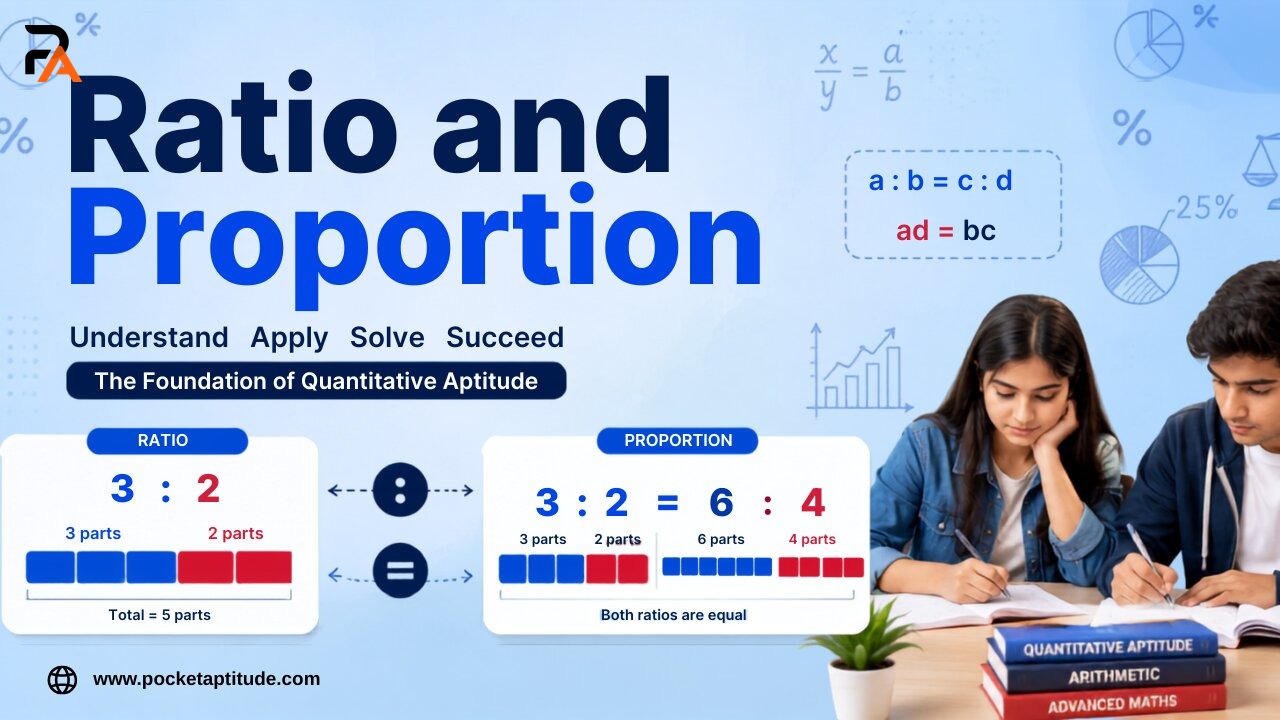
Ratio and Proportion Aptitude
Ratio and Proportion is one of the most important topics in quantitative aptitude. It forms the foundation for many arithmetic chapters such as Percentage, Profit and Loss, Partnership, Mixture and Alligation, Average, Time and Work, and Probability. Whether you’re preparing for TCS NQT, Infosys, Accenture, Wipro, Cognizant, Capgemini, SSC, Banking, Railways, CAT, or other competitive exams, mastering Ratio and Proportion can significantly improve your problem-solving speed and accuracy.
Many aptitude questions are based on comparing quantities or dividing values in a given ratio. Once you understand the core concepts, solving these questions becomes much easier.
In this guide, you’ll learn:
- What Ratio and Proportion mean
- Important formulas
- Key properties and rules
- Solved examples with step-by-step explanations
- Shortcut tricks
- Common mistakes to avoid
- Practice questions to test your understanding
By the end of this article, you’ll have a strong understanding of Ratio and Proportion and be ready to solve aptitude questions with confidence.
Quick Answer
A ratio compares two quantities of the same kind, while a proportion states that two ratios are equal.
Example
Suppose a classroom has:
- 15 Boys
- 10 Girls
The ratio of boys to girls is:
15 : 10 = 3 : 2
Now consider another classroom with:
- 30 Boys
- 20 Girls
The ratio is:
30 : 20 = 3 : 2
Since both ratios are equal,
15 : 10 = 30 : 20
This is called a proportion.
Why is Ratio and Proportion Important?
Ratio and Proportion is one of the highest-scoring arithmetic topics in aptitude exams. Many questions can be solved in less than a minute if you know the concepts well.
It is widely used in questions involving:
- Percentage
- Profit and Loss
- Discount
- Partnership
- Average
- Mixture and Alligation
- Time and Work
- Pipes and Cisterns
- Speed, Time and Distance
- Probability
Importance in Competitive Exams
| Exam | Importance |
|---|---|
| Campus Placements | ⭐⭐⭐⭐⭐ |
| TCS NQT | ⭐⭐⭐⭐⭐ |
| Banking Exams | ⭐⭐⭐⭐⭐ |
| SSC CGL | ⭐⭐⭐⭐⭐ |
| Railways | ⭐⭐⭐⭐☆ |
| CAT | ⭐⭐⭐⭐☆ |
Pocket Aptitude Tip: Mastering Ratio and Proportion makes many arithmetic topics easier because they are built on proportional relationships.
What is a Ratio?
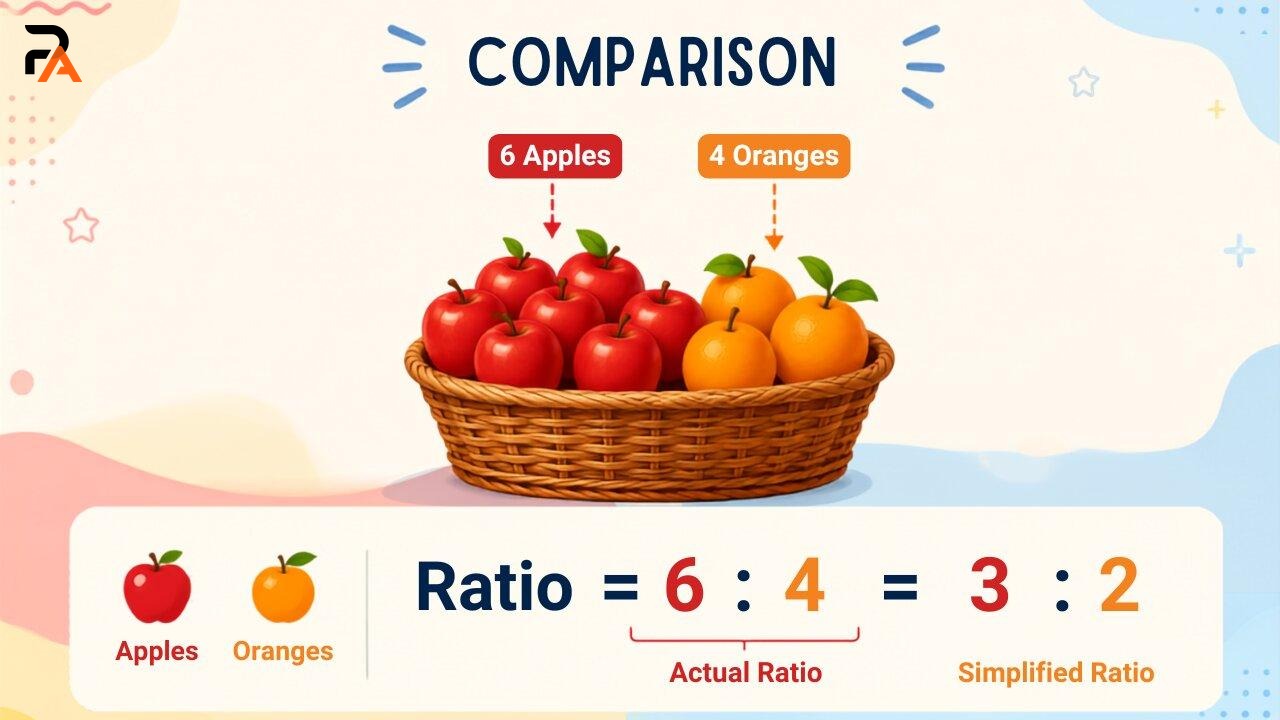
A ratio is a way of comparing two quantities of the same type. It tells us how much one quantity is compared to another.
The general form of a ratio is:
a : bWhere:
- a is called the Antecedent
- b is called the Consequent
Example 1
A basket contains:
- 8 Apples
- 12 Oranges
Ratio of Apples to Oranges:
8 : 12Divide both numbers by 4.
= 2 : 3This means that for every 2 apples, there are 3 oranges.
Real-Life Examples of Ratio
Example 1
A classroom has:
- 24 Boys
- 16 Girls
Ratio:
24 : 16Divide both numbers by 8.
= 3 : 2Example 2
A cricket team scores:
- First innings = 180 runs
- Second innings = 240 runs
Ratio:
180 : 240Simplify:
= 3 : 4Example 3
The ratio of tea powder to sugar in a recipe is 4 : 1.
This means for every 4 spoons of tea powder, 1 spoon of sugar is used.
Terms Used in Ratio
Consider the ratio:
5 : 8- 5 → Antecedent
- 8 → Consequent
Knowing these terms can help in theoretical aptitude questions.
Properties of Ratio
1. Ratio Has No Unit
A ratio compares similar quantities, so the units cancel out.
Example:
5 kg : 10 kg = 1 : 22. Both Quantities Must Have the Same Unit
❌ Incorrect
2 m : 50 cm✅ Correct
Convert metres into centimetres.
200 cm : 50 cm = 4 : 1This is one of the most common mistakes students make.
3. Ratios Should Always Be Simplified
Example:
30 : 45Divide both numbers by 15.
= 2 : 3Simplified ratios make calculations faster and easier.
4. Multiplying or Dividing Both Terms by the Same Number Does Not Change the Ratio
Example:
3 : 5Multiply by 2:
6 : 10Multiply by 3:
18 : 30All these ratios are equivalent.
What is a Proportion?
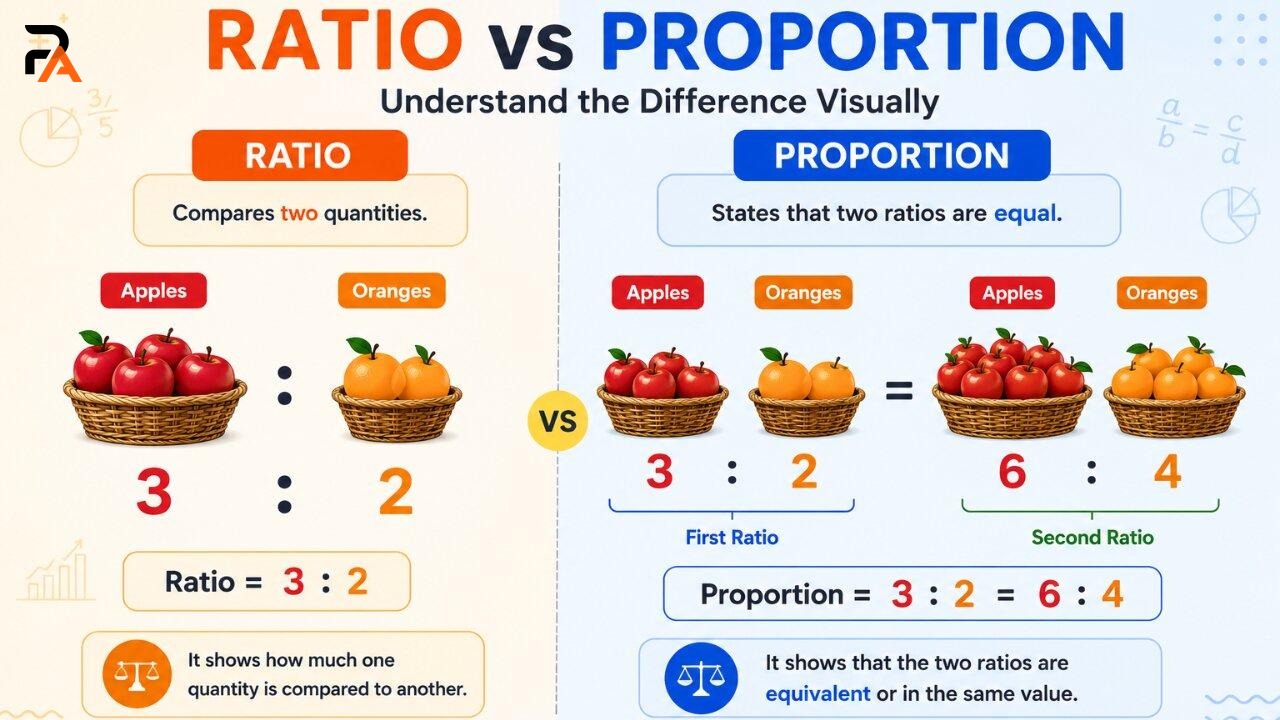
A proportion is an equation that states two ratios are equal.
General form:
a : b = c : dExample:
2 : 5 = 4 : 10Since
2/5 = 4/10the two ratios are equal.
Therefore, they are said to be in proportion.
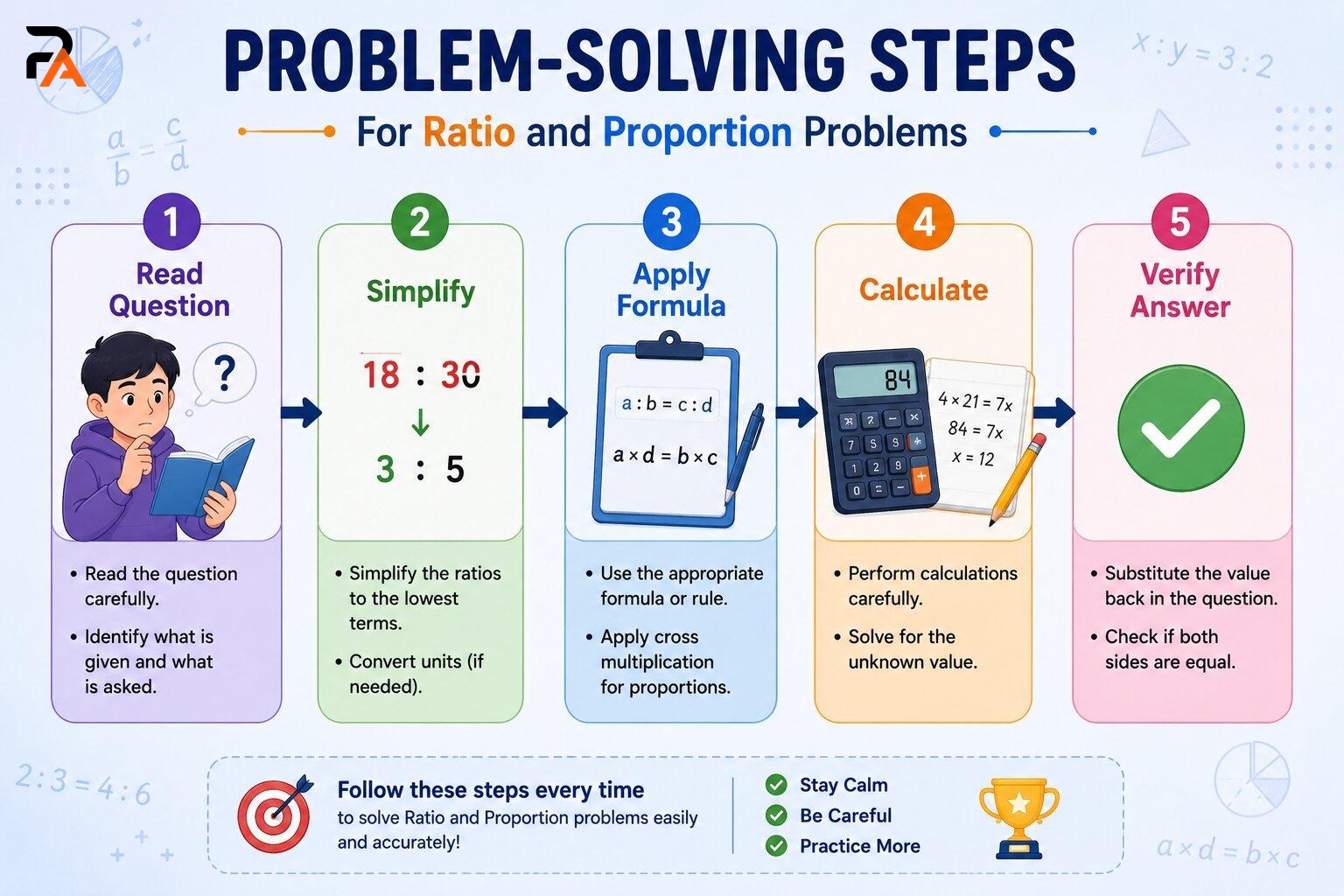
Cross Multiplication Rule
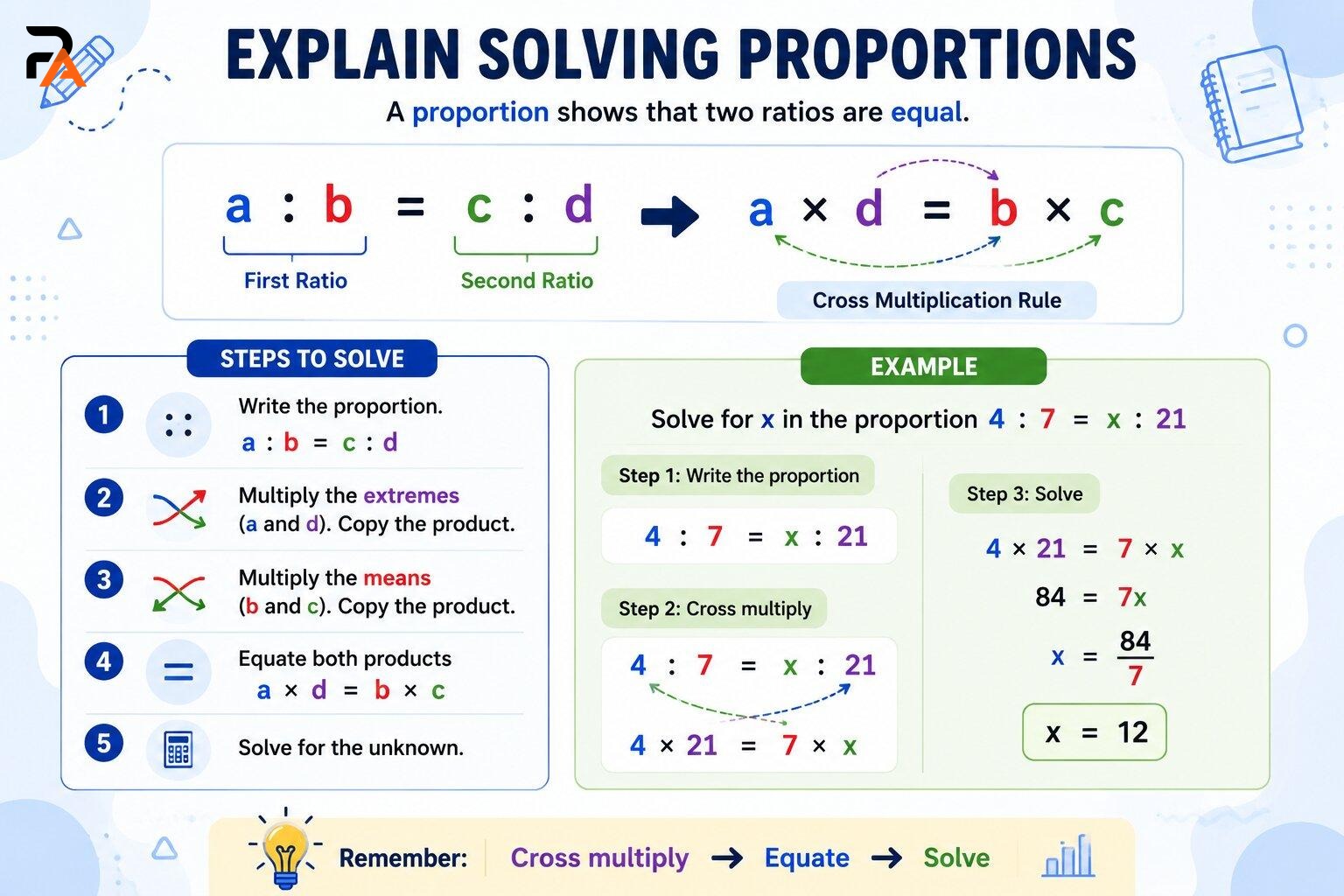
If
a : b = c : dthen
a × d = b × cThis rule is called cross multiplication and is one of the fastest methods for solving proportion problems.
Example
Find x if
4 : 7 = x : 21Cross multiply:
4 × 21 = 7 × x
84 = 7x
x = 12
Answer: 12
Difference Between Ratio and Proportion
| Ratio | Proportion |
|---|---|
| Compares two quantities | Compares two ratios |
| Written using ”:“ | Written using ”=“ |
| Shows comparison | Shows equality |
| Example: 3 : 4 | Example: 3 : 4 = 6 : 8 |
Remember: A Ratio compares, while a Proportion proves equality.
Important Formulas
| Concept | Formula |
|---|---|
| Ratio | a : b |
| Proportion | a : b = c : d |
| Cross Multiplication | ad = bc |
| Simplified Ratio | Divide both terms by their HCF |
Solved Examples
Example 1: Simplify the Ratio
Simplify:
18 : 30Solution
HCF of 18 and 30 = 6
18 ÷ 6 = 3
30 ÷ 6 = 5
Answer: 3 : 5
Example 2: Convert Units Before Finding Ratio
Find the ratio:
40 minutes : 2 hoursSolution
Convert 2 hours into minutes.
2 hours = 120 minutesRatio:
40 : 120Divide both numbers by 40.
Answer: 1 : 3
Example 3: Find the Missing Quantity
The ratio of boys to girls is 7 : 5.
If there are 35 boys, how many girls are there?
Solution
7 parts = 35
1 part = 35 ÷ 7 = 5
Girls = 5 × 5
Answer: 25 Girls
Example 4: Find the Missing Term in a Proportion
Find x if:
9 : 15 = x : 25Solution
9 × 25 = 15 × x
225 = 15x
x = 15
Answer: 15
Example 5: Divide an Amount in a Given Ratio
A sum of ₹6,500 is divided between A and B in the ratio 4 : 9.
Solution
Total parts = 13
One part = ₹6,500 ÷ 13 = ₹500

A = 4 × ₹500 = ₹2,000
B = 9 × ₹500 = ₹4,500
Answer:
- A = ₹2,000
- B = ₹4,500
Pocket Aptitude Tip: For sharing problems, always calculate the value of one part first.
Example 6: Age-Based Ratio Problem
The ratio of the ages of A and B is 3 : 5.
If A is 18 years, find B’s age.
Solution
3 parts = 18
1 part = 6
B = 5 × 6 = 30
Answer: 30 years
Time-Saving Tricks
1. Simplify Ratios First
Always reduce the ratio to its simplest form before solving.
Example:
84 : 126Divide both numbers by 42.
= 2 : 32. Convert Units Before Comparing
Never compare different units directly.
❌ Incorrect
3 m : 75 cm✅ Correct
Convert metres into centimetres.
300 cm : 75 cm
= 4 : 1
3. Use the Total Parts Method
When money, students, or objects are divided in a ratio, first find the total number of parts.
Example:
Ratio = 3 : 7
Total Amount = ₹500
Total Parts = 3 + 7 = 10

One Part = ₹500 ÷ 10 = ₹50

3 Parts = ₹150

7 Parts = ₹350
4. Use Cross Multiplication
Whenever two ratios are equal, use cross multiplication immediately.
Example:
5 : 8 = x : 32Cross multiply:
5 × 32 = 8 × x

160 = 8x

x = 20
Common Mistakes to Avoid
❌ Comparing Quantities with Different Units
Always convert all quantities into the same unit before finding the ratio.
Example
❌ 2 m : 50 cm
✅ 200 cm : 50 cm = 4 : 1
❌ Forgetting to Simplify the Ratio
Always reduce the ratio to its simplest form.
Example:
30 : 45

= 2 : 3
❌ Reversing the Order of Comparison
Read the question carefully.
Example
Boys : Girls ≠ Girls : BoysChanging the order changes the meaning of the ratio.
❌ Applying Cross Multiplication Incorrectly
Multiply diagonally and solve step by step.
❌ Treating a Ratio as a Fraction
A ratio compares two quantities, while a fraction represents a part of a whole.
Pocket Aptitude Tip: Spend a few extra seconds checking the units and the order of comparison before solving. This helps avoid common mistakes in aptitude exams.
Practice Questions
Try solving these questions before checking the answers.
Question 1
Simplify the ratio:
24 : 36Answer: 2 : 3
Question 2
Find the ratio:
45 minutes : 3 hoursAnswer: 1 : 4
Question 3
The ratio of boys to girls is 5 : 4.
If there are 40 boys, how many girls are there?
Answer: 32
Question 4
Find x if
4 : 7 = x : 28Answer: 16
Question 5
The ratio of two numbers is 2 : 5.
Their sum is 42.
Find the numbers.
Answer: 12 and 30
Formula Summary
| Concept | Formula |
|---|---|
| Ratio | a : b |
| Proportion | a : b = c : d |
| Cross Multiplication | ad = bc |
| Simplified Ratio | Divide both terms by their HCF |
Revision Tips
Before your exam, remember these important points:
- Convert quantities into the same unit before comparing.
- Always simplify ratios whenever possible.
- Use cross multiplication to solve proportions.
- Read the order of comparison carefully.
- Apply the Total Parts Method for sharing problems.
- Practice different types of ratio questions to improve your speed and accuracy.
Frequently Asked Questions (FAQs)
1. What is a ratio
A ratio compares two quantities of the same kind and shows their relationship using the symbol :.
2. What is a proportion?
A proportion is an equation that states two ratios are equal.
Example
2 : 3 = 4 : 63. Why should ratios be simplified?
Simplified ratios make calculations easier, reduce errors, and help solve aptitude questions more quickly.
4. What is cross multiplication?
Cross multiplication is a shortcut used to solve proportions.
If a : b = c : d,

then

a × d = b × c
5. Is Ratio and Proportion important for placement exams?
Yes. Ratio and Proportion is one of the most frequently asked arithmetic topics in placement tests and competitive exams such as TCS NQT, Infosys, Accenture, Wipro, SSC, Banking, Railways, and CAT.
6. Which aptitude topics are based on Ratio and Proportion?
Many arithmetic topics use the concepts of Ratio and Proportion, including:
- Percentage
- Profit and Loss
- Discount
- Average
- Partnership
- Mixture and Alligation
- Time and Work
- Probability
- Speed, Time and Distance
Related Articles
Continue your aptitude preparation with these guides on Pocket Aptitude:
- Percentage Aptitude Guide
- Profit and Loss Aptitude Guide
- Discount Aptitude Guide
- Simple Interest Aptitude Guide
- Average
- Time and Work
- Partnership
- Mixture and Alligation
Final Thoughts
Ratio and Proportion is one of the most important building blocks of quantitative aptitude. Instead of memorizing formulas, focus on understanding how quantities relate to each other. Once you grasp the concepts and practice different types of questions, you’ll be able to solve problems quickly and confidently.
Whether you’re preparing for campus placements, banking exams, SSC, Railways, CAT, or other competitive exams, mastering Ratio and Proportion will strengthen your arithmetic skills and make many advanced aptitude topics easier to learn.
Pocket Aptitude Exam Tip: Spend a few minutes revising Ratio and Proportion every week. Since many arithmetic topics are based on proportional relationships, a strong foundation in this chapter will improve your overall aptitude performance.