Discount Aptitude: Master Marked Price, Selling Price & Discount Questions

Whether you’re preparing for TCS NQT, Infosys, Accenture, Wipro, SSC, Banking, CAT, or other placement exams, Discount is one of the quickest topics to score marks in quantitative aptitude. Most questions involve simple percentage calculations and can be solved in under a minute if you know the right formulas.
In this guide, you’ll learn the core concepts of Discount, Marked Price (MP), Selling Price (SP), important formulas, placement-focused tips, and shortcut techniques that help you solve aptitude questions faster and with greater accuracy.
⚡ Quick Formula Revision
Before diving into the concepts, here’s a quick revision of the formulas you’ll use most often.
| Formula | Expression |
|---|---|
| Discount | MP − SP |
| Selling Price | MP − Discount |
| Discount Percentage | (Discount ÷ MP) × 100 |
| Marked Price | SP + Discount |
| Selling Price (Using %) | MP × (100 − Discount%) ÷ 100 |
💡 Quick Tip: Save this table for last-minute revision before your placement tests.
📚 In This Guide
You’ll learn:
- What Discount means
- Marked Price (MP) and Selling Price (SP)
- Relationship between MP, SP, and Discount
- Important discount formulas
- Successive discounts
- Equivalent discount formula
- Placement shortcut techniques
- Solved examples
- Practice questions
- FAQs
Why is Discount Important in Placement Exams?
Discount is one of the easiest scoring topics in quantitative aptitude because most questions are based on a few simple formulas and percentage calculations.
You’ll frequently encounter discount questions in:
- TCS NQT
- Infosys
- Accenture
- Wipro
- Cognizant
- Capgemini
- Campus Placement Tests
- SSC
- Banking Exams
- Railway Exams
- Other Government Competitive Exams
Learning Discount also makes it easier to understand topics like:
- Percentages
- Profit and Loss
- Simple Interest
- Compound Interest
- Ratio and Proportion
🎯 Exam Insight
Discount questions rarely appear alone in placement exams.
Companies often combine Discount, Percentages, and Profit & Loss into a single question. If you’re comfortable with these three topics, you’ll be able to solve many mixed aptitude problems much faster.
What is Discount?
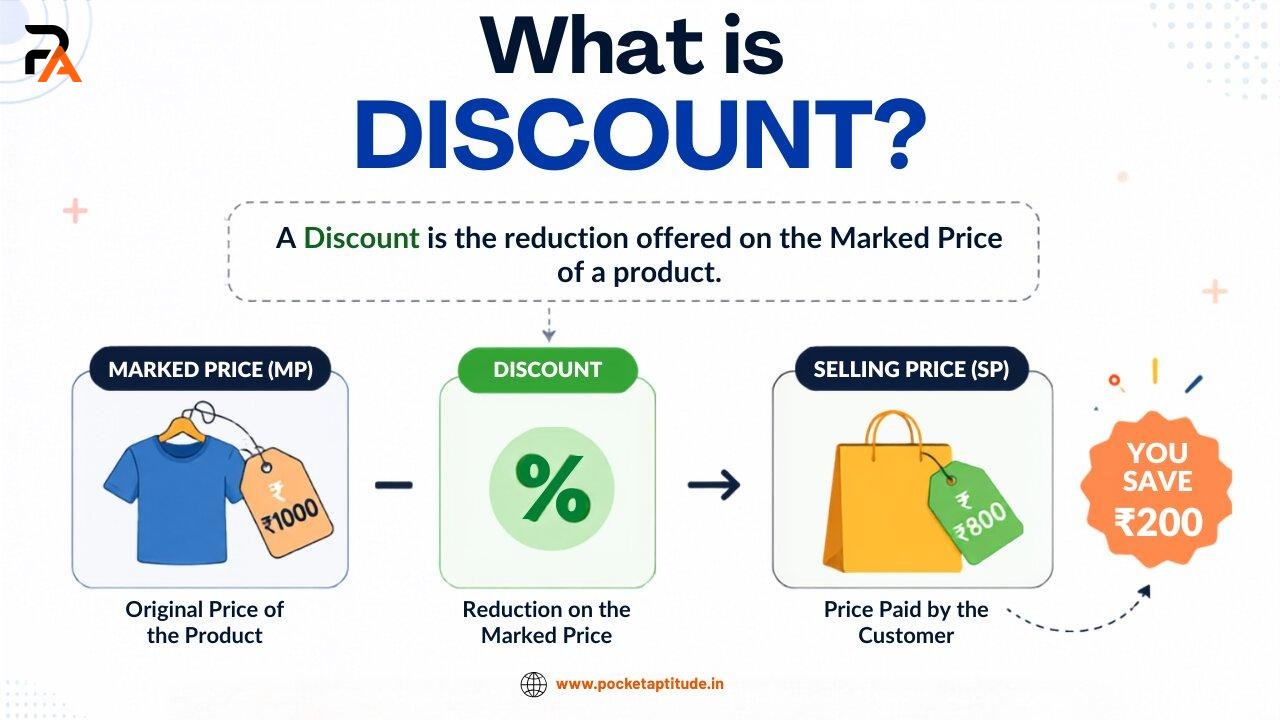
A Discount is the reduction offered on the Marked Price of a product. It is used by sellers to encourage customers to purchase products at a lower price.
Example
A mobile phone has a marked price of ₹20,000.
The shop offers a 10% discount.
The customer pays less than ₹20,000 after the discount is applied.
What is Marked Price (MP)?
The Marked Price (MP), also called the List Price, is the original price printed on a product before any discount is offered.
Example
A laptop has a price tag of ₹50,000.
Marked Price = ₹50,000
If a discount is announced, the customer will pay less than this amount.
What is Selling Price (SP)?
The Selling Price (SP) is the amount that the customer actually pays after subtracting the discount from the marked price.
Example
- Marked Price = ₹2,000
- Discount = ₹200
Selling Price = ₹1,800
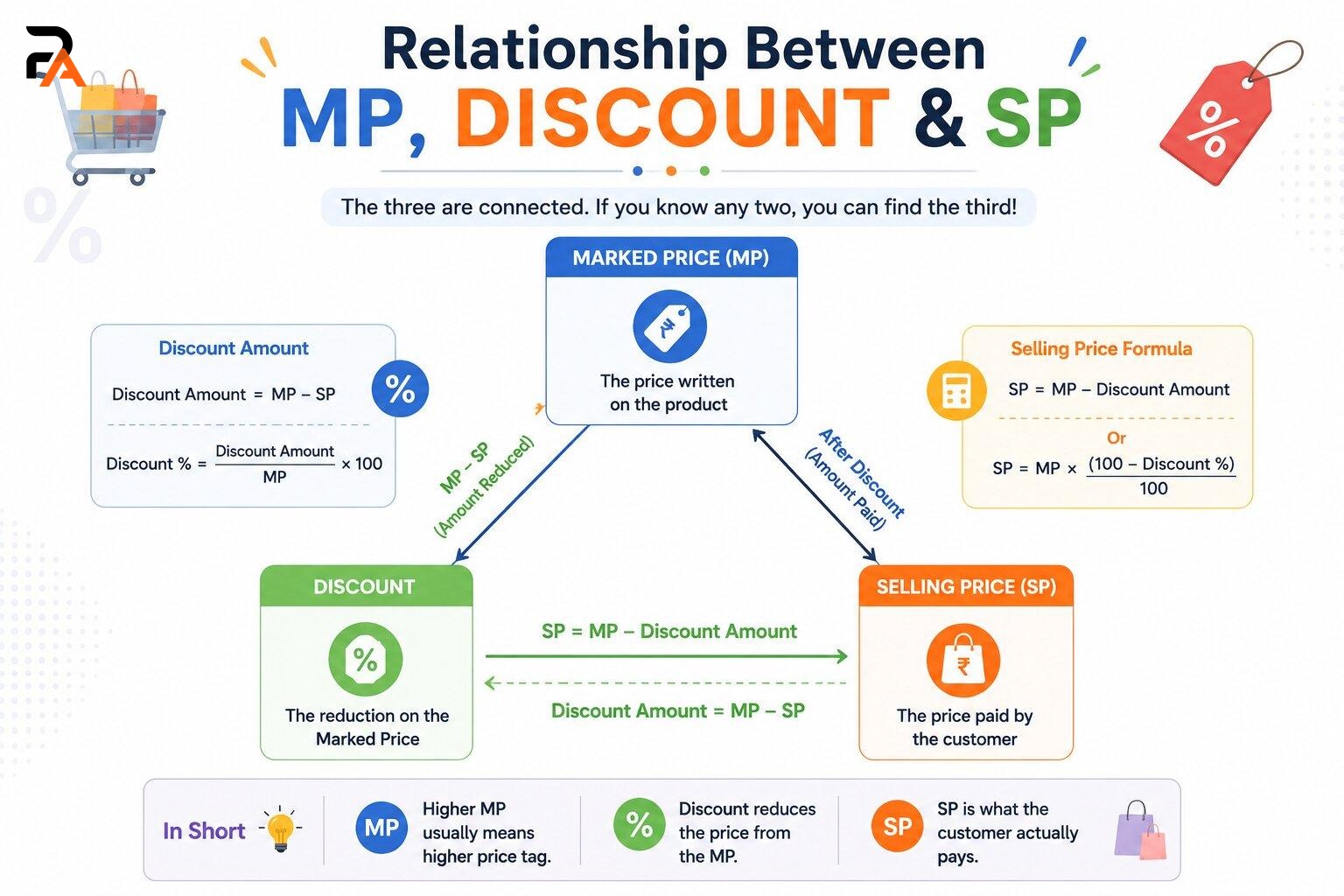
Relationship Between Marked Price, Discount and Selling Price
The three values are directly connected.
Selling Price = Marked Price − Discount
This relationship forms the foundation of almost every discount question asked in aptitude exams.
| Term | Meaning |
|---|---|
| Marked Price (MP) | Original listed price of the product |
| Discount | Reduction offered on the marked price |
| Selling Price (SP) | Final amount paid after discount |
Understanding this relationship helps you quickly identify which formula to use.
Discount Formula Cheat Sheet
These are the most important formulas for placement exams.
| Formula | Expression |
|---|---|
| Discount | MP − SP |
| Selling Price | MP − Discount |
| Discount Percentage | (Discount ÷ MP) × 100 |
| Marked Price | SP + Discount |
| Discount Amount | (Discount% × MP) ÷ 100 |
💡 Pocket Aptitude Tip
Instead of calculating the discount amount first, think about the percentage that the customer actually pays.
| Discount | Customer Pays |
|---|---|
| 10% | 90% of MP |
| 20% | 80% of MP |
| 25% | 75% of MP |
| 30% | 70% of MP |
| 50% | Half of the MP |
This simple approach saves valuable time during placement exams.
Discount Percentage Formula
The discount percentage tells us how much of the marked price has been reduced.
Discount Percentage = (Discount ÷ Marked Price) × 100
Example
Marked Price = ₹1,000
Selling Price = ₹850
Discount = ₹150
Discount Percentage
= (150 ÷ 1000) × 100
= 15%
Selling Price Formula
The selling price can be calculated in two ways.
Method 1
Selling Price = Marked Price − Discount
Method 2 (When Discount Percentage is Given)
Selling Price = MP × (100 − Discount%) ÷ 100
Example
Marked Price = ₹4,000
Discount = 20%
Selling Price
= 4000 × 80 ÷ 100
= ₹3,200
Marked Price Formula
When the selling price and discount amount are known,
Marked Price = Selling Price + Discount
Example
Selling Price = ₹3,600
Discount = ₹400
Marked Price
= ₹3,600 + ₹400
= ₹4,000
Discount Amount Formula
The discount amount is calculated using:
Discount Amount = (Discount% × Marked Price) ÷ 100
Example
Marked Price = ₹2,500
Discount = 12%
Discount Amount
= (12 × 2500) ÷ 100
= ₹300
Successive Discounts
Sometimes shops offer more than one discount on the same product.
Examples include:
- 20% OFF + Additional 10% OFF
- 30% OFF + Additional 15% OFF
Remember that the second discount is always calculated on the reduced price, not on the original marked price.
Never add the percentages directly.
Instead, use the equivalent discount formula.
Equivalent Discount Formula
For two successive discounts a% and b%,
Equivalent Discount = a + b − (ab ÷ 100)
This converts multiple discounts into one single discount percentage, making calculations much easier.
Real-Life Applications of Discount
Discounts are used almost everywhere in daily life.
Some common examples include:
- Festival sales
- Online shopping offers
- Supermarket discounts
- Student discounts
- Senior citizen discounts
- Seasonal clearance sales
- Buy More, Save More offers
Understanding discounts helps you compare offers, calculate savings, and make smarter purchasing decisions.
⏱️ Time-Saving Tricks for Placement Exams
1. Find 10% First
Calculating 10% of a number is easy—just move the decimal point one place to the left.
Once you know 10%, you can quickly find:
- 20% = 2 × 10%
- 30% = 3 × 10%
- 40% = 4 × 10%
- 5% = Half of 10%
Example
Find 30% of ₹2,500
10% = ₹250
30% = 3 × 250 = ₹750
2. Remember Common Percentage Values
| Discount | Customer Pays |
|---|---|
| 50% | Half of the Marked Price |
| 25% | 75% of the Marked Price |
| 20% | 80% of the Marked Price |
| 10% | 90% of the Marked Price |
| 5% | 95% of the Marked Price |
Instead of calculating the discount first, directly calculate what the customer pays.
3. Don’t Add Successive Discounts
This is one of the most common mistakes students make.
Suppose a shop offers:
20% OFF + Additional 10% OFF
Many students incorrectly think the total discount is 30%.
Use the formula instead:
Equivalent Discount
= 20 + 10 − (20 × 10 ÷ 100)
= 30 − 2
= 28%
4. Learn the Core Formulas
Most placement questions can be solved using just these formulas.
- Discount = MP − SP
- Selling Price = MP − Discount
- Discount Percentage = (Discount ÷ MP) × 100
- Marked Price = SP + Discount
The more familiar you are with these formulas, the faster you’ll solve questions.
📘 Placement-Level Solved Examples
Example 1
A shirt has a marked price of ₹2,000 and is sold for ₹1,800.
Find the discount.
Solution
Discount
= MP − SP
= ₹2,000 − ₹1,800
= ₹200
Example 2
A product has a marked price of ₹1,500 and is offered at a 20% discount.
Find the selling price.
Solution
Discount
= (20 × 1,500) ÷ 100
= ₹300
Selling Price
= ₹1,500 − ₹300
= ₹1,200
Example 3
A bag costs ₹900 after discount.
Its marked price is ₹1,000.
Find the discount percentage.
Solution
Discount
= ₹1,000 − ₹900
= ₹100
Discount %
= (100 ÷ 1000) × 100
= 10%
🚀 Quick Challenge
Can you solve these in 30 seconds without using a calculator?
Challenge 1
Marked Price = ₹1,600
Discount = 25%
Answer: ₹1,200
Challenge 2
Marked Price = ₹3,000
Selling Price = ₹2,400
Find the discount.
Answer: ₹600
Challenge 3
A product is offered at 10% and 20% successive discounts.
Find the equivalent discount.
Answer: 28%
❌ Common Mistakes Students Make
Avoid these common errors while solving discount questions.
- Confusing Marked Price with Selling Price.
- Forgetting that discount is always calculated on the Marked Price.
- Adding successive discounts directly.
- Using the wrong formula for discount percentage.
- Forgetting to divide by 100 while calculating percentages.
- Reading the question too quickly and missing important information.
Tip: Always identify the values given in the question before choosing a formula.
📝 Practice Questions
- Find the selling price of a product marked at ₹2,500 with a 20% discount.
- A shirt is sold for ₹1,440 after a 10% discount. Find its marked price.
- A product has a marked price of ₹800 and is sold for ₹680. Find the discount percentage.
- Find the discount amount on a product marked at ₹3,000 with a 15% discount.
- A store offers successive discounts of 10% and 20%. Find the equivalent discount.
- Find the selling price after a 25% discount on a product costing ₹1,600.
- A customer saves ₹450 on a product marked at ₹4,500. Find the discount percentage.
- A bag marked at ₹2,200 is sold for ₹1,980. Find the discount amount.
- Find the marked price if the selling price is ₹2,700 after a discount of ₹300.
- A product marked at ₹5,000 is offered at a 30% discount. Find the selling price.
📚 Quick Revision Before Exams
Remember these four formulas:
- ✅ Discount = MP − SP
- ✅ Selling Price = MP − Discount
- ✅ Discount % = (Discount ÷ MP) × 100
- ✅ MP = SP + Discount
For successive discounts:
Equivalent Discount = a + b − (ab ÷ 100)
If you remember these formulas, you can solve most placement questions in less than a minute.
Frequently Asked Questions (FAQs)
1. What is a discount?
A discount is the reduction offered on the marked price of a product, allowing customers to buy it at a lower price.
2. What is the difference between Marked Price and Selling Price?
- Marked Price (MP): Original listed price.
- Selling Price (SP): Final price paid after deducting the discount.
3. How do I calculate the discount amount?
Use either formula:
- Discount = Marked Price − Selling Price
or
- Discount = (Discount% × Marked Price) ÷ 100
4. How do I calculate the selling price?
Selling Price = Marked Price − Discount
If the discount percentage is given:
Selling Price = MP × (100 − Discount%) ÷ 100
5. What are successive discounts?
Successive discounts are two or more discounts applied one after another on the same product. The second discount is always calculated on the reduced price, not on the original marked price.
Related Topics
Continue your aptitude preparation with these important topics:
- Percentages
- Profit and Loss
- Simple Interest
- Compound Interest
- Ratio and Proportion
These topics are closely connected and are frequently asked together in placement and competitive exams.
Conclusion
Discount is one of the highest-scoring topics in quantitative aptitude because it relies on a small set of formulas and simple percentage calculations. By understanding the relationship between Marked Price, Selling Price, and Discount, you can solve most questions quickly and accurately.
Focus on memorizing the core formulas, practicing shortcut techniques, and understanding successive discounts. With regular practice, you’ll improve your speed and confidence, making it easier to tackle placement tests and competitive exams.
💡 Pocket Aptitude Tip
Spend just 10–15 minutes practicing discount questions each day. Consistent practice will significantly improve your calculation speed and accuracy before your placement exams.