Time, Speed and Distance Aptitude: Complete Guide
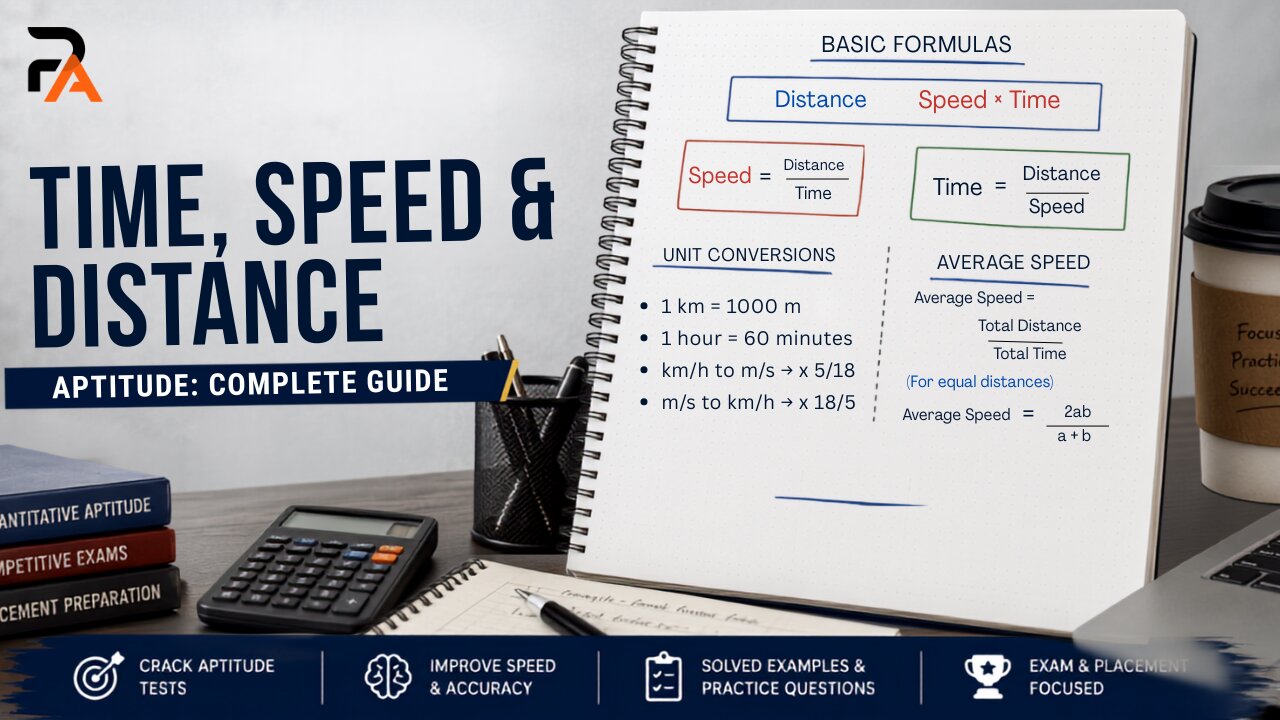
Time, Speed and Distance Aptitude: Complete Guide
Time, Speed and Distance is one of the most frequently asked topics in aptitude exams. Whether you’re preparing for campus placements, SSC, Banking, Railways, CAT, UPSC, or other competitive exams, mastering this topic can help you solve questions quickly and accurately.
Unlike many other aptitude topics, Time, Speed and Distance is highly formula-based. Once you understand the relationship between these three quantities, solving even complex questions becomes much easier.
In this guide, you’ll learn:
- What Time, Speed and Distance means
- Important formulas
- Unit conversions
- Average speed
- Solved examples
- Common mistakes
- Quick revision tips
Quick Answer
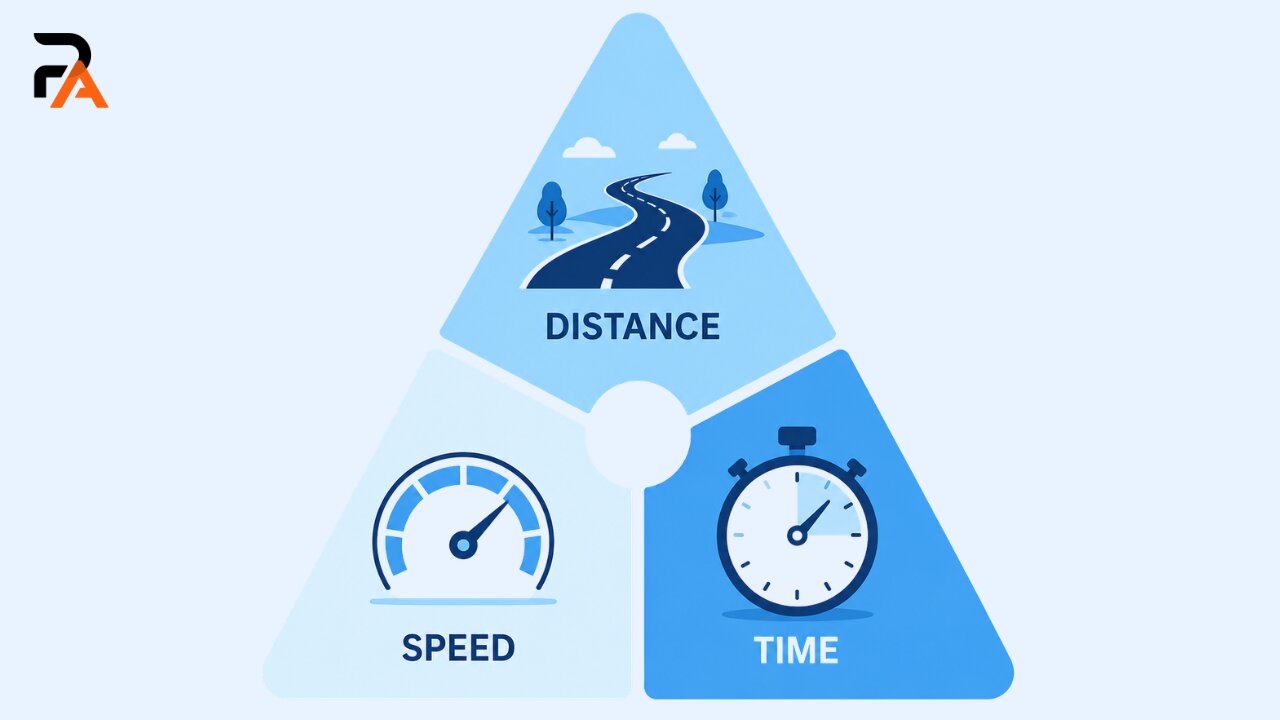
Time, Speed and Distance are connected using one simple relationship:
Distance = Speed × Time
From this formula, we can also derive:
- Speed = Distance ÷ Time
- Time = Distance ÷ Speed
Formula Triangle
        Distance
     ─────────────
      Speed × Time
Knowing this relationship is enough to solve a large percentage of aptitude questions.
What is Time, Speed and Distance?
Let’s understand each term individually.
Time
Time tells us how long an object takes to travel.
Examples
- A student walks to college in 20 minutes
- A train reaches Chennai in 5 hours
- A car completes a journey in 2.5 hours
Common Units
- Seconds (s)
- Minutes (min)
- Hours (hr)
Speed
Speed tells us how fast an object moves.
Examples
- Walking speed = 5 km/h
- Bicycle = 15 km/h
- Car = 60 km/h
- Train = 90 km/h
Speed is written as:
Distance per unit time
Examples:
- km/h
- m/s
- miles/hour
Distance
Distance is the total length travelled from one point to another.
Examples
- Home to office = 12 km
- Chennai to Madurai = 460 km
- School playground = 300 m
Distance is measured in:
- Metres
- Kilometres
- Miles
Why Time, Speed and Distance Matters
This topic appears regularly in competitive exams because it tests logical thinking and calculation skills.
You’ll frequently see questions involving:
- Cars
- Bikes
- Trains
- Flights
- Boats
- Walking
- Running
- Races
- Relative Speed
Typical exam questions include:
- A train crosses a platform.
- Two cars move towards each other.
- A cyclist reaches late due to reduced speed.
- A person walks and runs different distances.
- Boats move upstream and downstream.
Since these questions follow standard formulas, learning the concepts properly can save valuable exam time.
Distance, Speed and Time Formula
Formula 1
Distance = Speed × Time
Example
Speed = 60 km/h
Time = 4 hours
Distance = 60 × 4
= 240 km
Formula 2
Speed = Distance ÷ Time
Example
Distance = 180 km
Time = 3 hours
Speed = 180 ÷ 3
= 60 km/h
Formula 3
Time = Distance ÷ Speed
Example
Distance = 150 km
Speed = 50 km/h
Time = 150 ÷ 50
= 3 hours
Formula Summary
| Find | Formula |
|---|---|
| Distance | Speed × Time |
| Speed | Distance ÷ Time |
| Time | Distance ÷ Speed |
This table alone is enough to solve many beginner-level aptitude questions.
Units and Conversions
One of the biggest reasons students lose marks is forgetting to convert units.
For example:
- Distance in metres
- Speed in km/h
- Time in minutes
These must all be converted into compatible units before applying formulas.
Kilometres and Metres
- 1 km = 1000 m
- 500 m = 0.5 km
Hours and Minutes
- 1 hour = 60 minutes
- 30 minutes = 0.5 hour
- 15 minutes = 0.25 hour
- 45 minutes = 0.75 hour
km/h to m/s
Multiply by:
5/18
Example:
72 km/h
= 72 × 5/18
= 20 m/s
m/s to km/h
Multiply by:
18/5
Example:
15 m/s
= 15 × 18/5
= 54 km/h
Conversion Table
| Convert | Multiply By |
|---|---|
| km/h → m/s | 5/18 |
| m/s → km/h | 18/5 |
| Hours → Minutes | ×60 |
| Minutes → Hours | ÷60 |
| km → metres | ×1000 |
| metres → km | ÷1000 |

Average Speed
Average speed is another favourite exam topic.
Many students think they can simply average two speeds.
This is not always correct.
Average Speed means:
Average Speed = Total Distance ÷ Total Time
Example
A car travels:
- 60 km in 1 hour
- 40 km in 1 hour
Total Distance = 100 km
Total Time = 2 hours
Average Speed = 100 ÷ 2 = 50 km/h
Important Note
If equal distances are covered at different speeds, use:
Average Speed = 2ab ÷ (a + b)
Where:
- a = First speed
- b = Second speed
Example
40 km at 40 km/h
40 km at 60 km/h
Average Speed
= (2 × 40 × 60) ÷ (40 + 60)
= 48 km/h
Basic Solved Examples
Example 1
A bus travels at 45 km/h for 4 hours.
Solution
Distance = Speed × Time
= 45 × 4
= 180 km
Example 2
A train covers 300 km in 5 hours.
Solution
Speed = Distance ÷ Time
= 300 ÷ 5
= 60 km/h
Example 3
A cyclist covers 96 km at 24 km/h.
Solution
Time = Distance ÷ Speed
= 96 ÷ 24
= 4 hours
Example 4
Convert 90 km/h into m/s.
Solution
90 × 5/18
= 25 m/s
Example 5
Convert 20 m/s into km/h.
Solution
20 × 18/5
= 72 km/h
Common Mistakes Students Make
- Forgetting unit conversions.
- Using the wrong formula.
- Incorrect average speed calculations.
- Depending too much on calculators.
- Ignoring important words like upstream, downstream, same direction, and opposite direction.
Pocket Aptitude Tip
💡 Remember the Formula Triangle.
        Distance
     ─────────────
      Speed × Time
Also memorize:
- 5/18
- 18/5
- 60 minutes = 1 hour
- 1000 metres = 1 km
Quick Revision Table
| Concept | Formula |
|---|---|
| Distance | Speed × Time |
| Speed | Distance ÷ Time |
| Time | Distance ÷ Speed |
| Average Speed | Total Distance ÷ Total Time |
| Equal Distance Average Speed | 2ab ÷ (a+b) |
| 1 km | 1000 m |
| 1 hour | 60 minutes |
| km/h → m/s | ×5/18 |
| m/s → km/h | ×18/5 |
Relative Speed
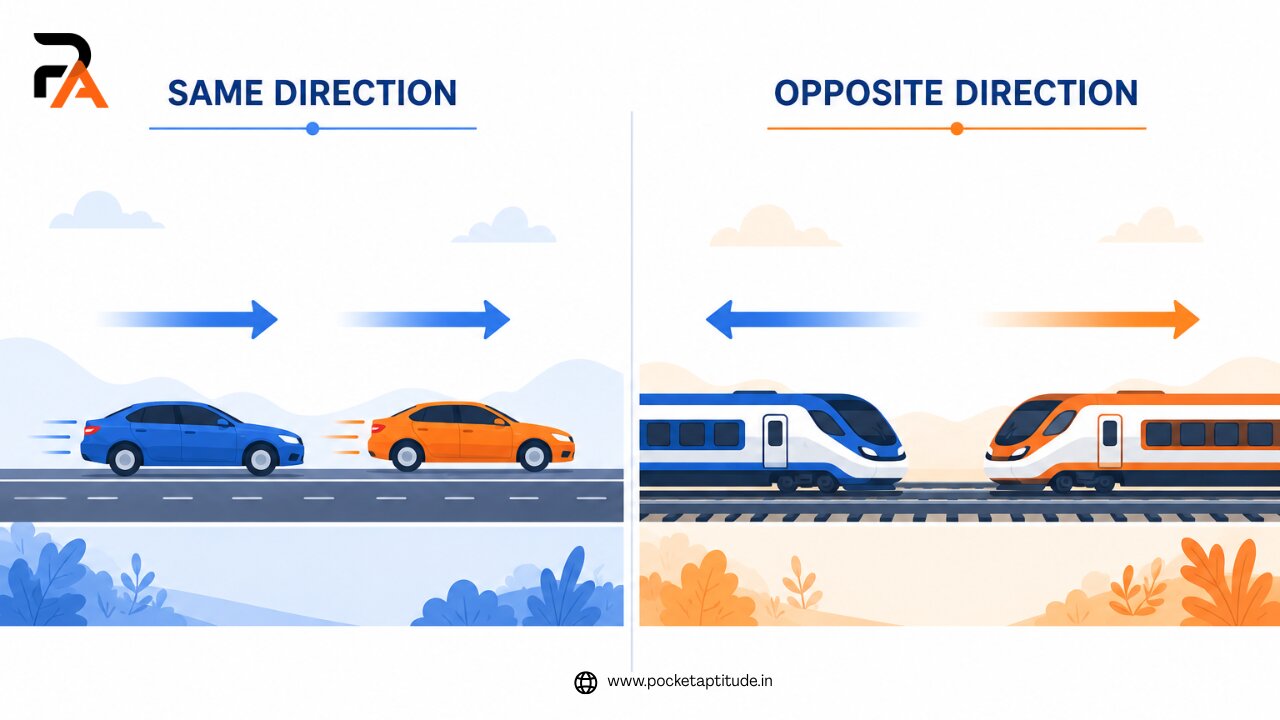
Relative speed refers to the speed of one moving object with respect to another.
Opposite Direction
Formula
Relative Speed = Speed₁ + Speed₂
Example
60 km/h + 40 km/h
= 100 km/h
Same Direction
Formula
Relative Speed = Faster Speed − Slower Speed
Example
70 − 50
= 20 km/h
Train Problems
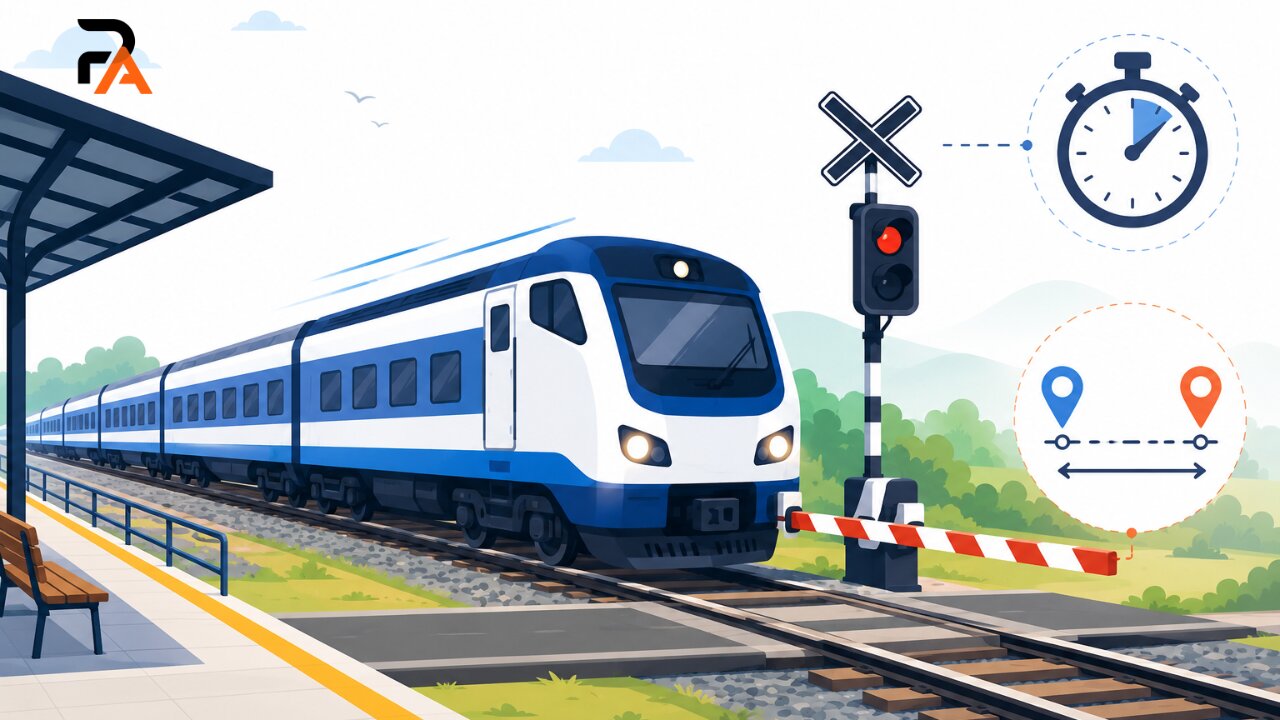
Train Crossing a Pole
Time = Length of Train ÷ Speed
Example
180 ÷ 18
= 10 seconds
Train Crossing a Platform
Distance = Train Length + Platform Length
Example:
180 + 120 = 300 m
Time = 300 ÷ 15
= 20 seconds
Two Trains Crossing Each Other
Relative Speed = Sum of Speeds
Distance = Total Length of Both Trains
Example:
400 ÷ 35
≈ 11.43 seconds
Boats and Streams
Downstream
Boat Speed + Stream Speed
Upstream
Boat Speed − Stream Speed
Example
Boat = 12 km/h
Stream = 4 km/h
Downstream = 16 km/h
Upstream = 8 km/h
Boat and Stream Speed
Boat Speed = (Downstream + Upstream) ÷ 2
Stream Speed = (Downstream − Upstream) ÷ 2
Circular Track Problems
Same Direction
Time = Track Length ÷ Difference of Speeds
Example:
400 ÷ 2
= 200 seconds
Opposite Direction
Time = Track Length ÷ Sum of Speeds
Example:
500 ÷ 15
≈ 33.33 seconds
Speed-Time Shortcut Tricks
- Convert units before solving.
- km/h → m/s = ×5/18
- m/s → km/h = ×18/5
- Pole → Train Length only
- Platform → Train + Platform
- Same Direction → Subtract speeds
- Opposite Direction → Add speeds
- Downstream → Add stream speed
- Upstream → Subtract stream speed
Placement Interview Tips
- Memorize formulas.
- Practice conversions.
- Learn shortcuts.
- Avoid calculators while practicing.
- Solve previous placement papers.
- Focus on accuracy before speed.
- Revise train and boat questions frequently.
10 Solved Questions
A car travels 240 km in 4 hours. Find its speed.
SolutionA train 200 m long crosses a pole in 20 seconds. Find its speed.
SolutionA boat travels downstream at 18 km/h and upstream at 10 km/h. Find the speed of the boat in still water.
SolutionUsing the previous question, find the speed of the stream.
SolutionTwo trains move in opposite directions at 45 km/h and 55 km/h. Find their relative speed.
SolutionTwo cyclists move in the same direction at 22 km/h and 15 km/h. Find their relative speed.
SolutionConvert 90 km/h into m/s.
SolutionConvert 20 m/s into km/h.
SolutionA train covers 450 km in 6 hours. Find its speed.
SolutionA car travels at 50 km/h for 3 hours. Find the distance travelled.
Solution
20 Practice Questions
A car travels 360 km in 6 hours. Find the speed.
Convert 54 km/h into m/s.
Convert 15 m/s into km/h.
Find the time to travel 240 km at 60 km/h.
A train 180 m long crosses a pole at 15 m/s.
A train 220 m long crosses a 180 m platform.
Find downstream speed.
Find upstream speed.
Find relative speed.
Same direction relative speed.
Find average speed.
Find travelling time.
Runner completes one lap.
Two runners meet.
Find car speed.
Convert 108 km/h.
Convert 30 m/s.
Find train speed.
Find boat speed.
Find platform crossing time.
Frequently Asked Questions
What is the most important formula?
Distance = Speed × Time
How do I convert km/h into m/s?
Multiply by 5/18.
How do I convert m/s into km/h?
Multiply by 18/5.
What is Relative Speed?
The speed of one moving object with respect to another.
How are train problems solved?
Use the total distance covered and divide it by the appropriate speed.
Which exams ask these questions?
Campus Placements, SSC, Banking, Railways, CAT, UPSC, Defence, and State Government exams.
Related Articles
- Percentage Aptitude Guide
- Profit and Loss Aptitude Guide
- Discount Aptitude Guide
- Ratio and Proportion Aptitude Guide
- Simple Interest Aptitude Guide
Summary
Time, Speed and Distance is one of the highest-scoring aptitude topics in competitive exams. By understanding the relationship between time, speed, and distance, mastering unit conversions, and practicing advanced topics such as relative speed, trains, boats and streams, and circular tracks, you can solve questions quickly and accurately. Regular revision and consistent practice will significantly improve your performance in placement tests and competitive examinations.