Probability Questions with Answers: Formula, Examples & Practice
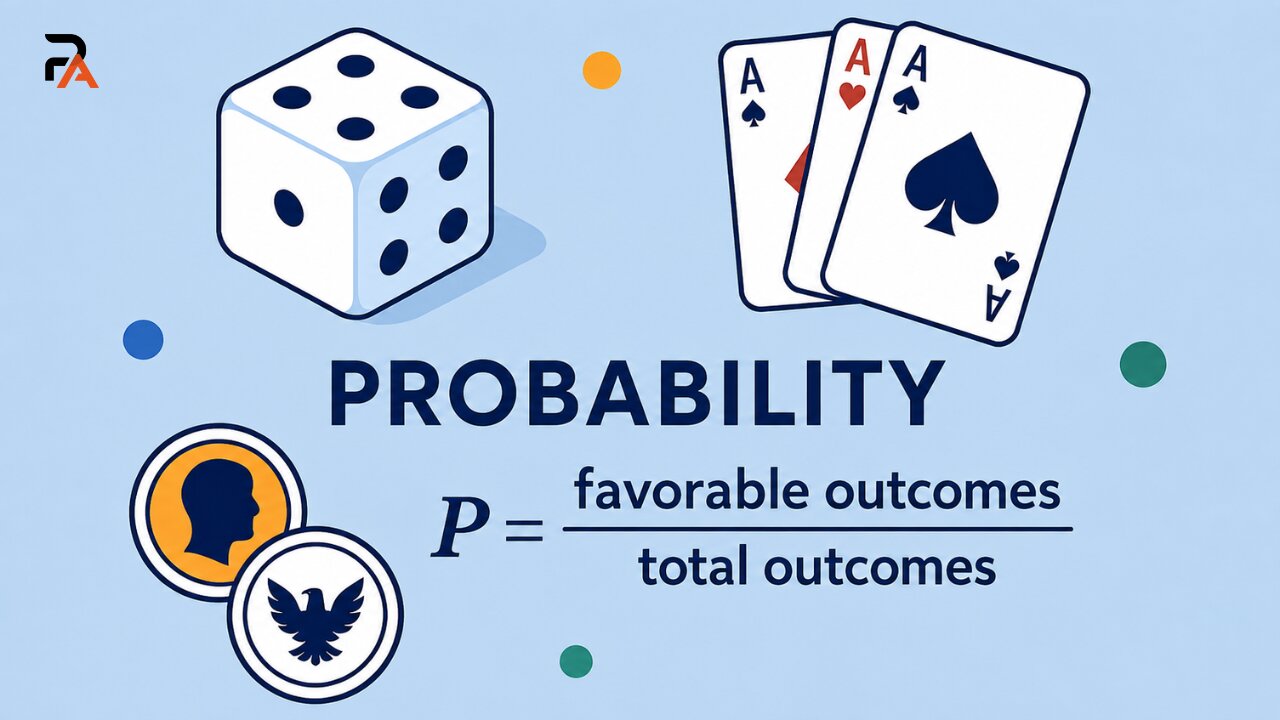
Probability Questions with Answers
Probability is one of the important topics in quantitative aptitude. It is used to measure how likely an event is to happen.
For example, when a coin is tossed, the possible outcomes are Head and Tail. Probability helps us determine the chance of getting either outcome.
Probability questions can look difficult at first, but most basic aptitude problems follow a simple process: identify the possible outcomes, find the favourable outcomes, and apply the appropriate probability rule.
In this guide, you will learn the basic probability concept, important formulas, solved examples, common mistakes, and practice questions with answers.
What is Probability?
Probability is a measure of the likelihood that an event will happen.
In simple words:
Probability tells us how likely something is to happen.
For example, consider a standard six-sided die.
The possible outcomes are:
1, 2, 3, 4, 5, 6
If we roll the die, there is a chance of getting any one of these numbers.
The probability of getting a particular number, such as 4, is:
1/6
because there is 1 favourable outcome and 6 total possible outcomes.
Important terms in Probability
Before solving probability questions, understand these three terms.
| Term | Meaning |
|---|---|
| Experiment | An activity that produces an outcome |
| Outcome | A possible result of the experiment |
| Event | The outcome or group of outcomes we are interested in |
Example
When a coin is tossed:
- Experiment: Tossing the coin
- Possible outcomes: Head and Tail
- Event: Getting Head
Understanding these terms makes probability questions much easier to solve.
Try It: Spin the Wheel
A spinner is one of the simplest ways to see probability instead of just calculating it — the size of each colored slice is exactly its probability.
Basic Probability Formula
For equally likely outcomes, the basic probability formula is:
Probability = Favourable Outcomes / Total Number of Outcomes
Or:
P(E) = Favourable outcomes / Total outcomes
Here:
P(E)= Probability of event E- Favourable outcomes = outcomes that satisfy the condition in the question
- Total outcomes = all possible outcomes
Example
A die is rolled once. What is the probability of getting an even number?
The possible outcomes are:
1, 2, 3, 4, 5, 6
The even numbers are:
2, 4, 6
So:
- Favourable outcomes = 3
- Total outcomes = 6
Therefore:
P(Even number) = 3/6
= 1/2
Answer: 1/2
Pocket Aptitude Tip: Before applying the formula, always identify the total outcomes and favourable outcomes separately.
Range of Probability
The value of probability always lies between 0 and 1.
| Probability | Meaning |
|---|---|
| 0 | Impossible event |
| Between 0 and 1 | Possible event |
| 1 | Certain event |
Example of an impossible event
What is the probability of getting 8 when a standard die is rolled?
A standard die contains only:
1, 2, 3, 4, 5, 6
Getting 8 is impossible.
Therefore:
P(8) = 0
Example of a certain event
What is the probability of getting a number less than 7 when a standard die is rolled?
Every possible outcome is less than 7.
Therefore:
P(Number < 7) = 1
Remember: Probability can never be less than 0 or greater than 1.
Try It: Where Does It Fall?
Every probability is a single point somewhere on this line. Pick an event and see exactly where.
Probability of an Event Not Happening
Sometimes a question asks for the probability that an event does not occur.
This is called the complement of an event.
The formula is:
P(Not A) = 1 - P(A)
Example
The probability that a student answers a question correctly is 3/5.
What is the probability that the student does not answer it correctly?
Using the complement rule:
P(Not A) = 1 - P(A)
= 1 - 3/5
= 2/5
Answer: 2/5
This rule is especially useful when calculating the probability of an event such as “at least one”.
Probability with Coins
A fair coin has two possible outcomes:
- Head
- Tail
Therefore:
P(Head) = 1/2
and
P(Tail) = 1/2
Example 1: One coin
A coin is tossed once. What is the probability of getting Head?
There is:
- 1 favourable outcome: Head
- 2 total outcomes: Head, Tail
Therefore:
P(Head) = 1/2
Answer: 1/2
Example 2: Two coins
Two coins are tossed together. What is the probability of getting exactly one Head?
There are 4 possible combined outcomes when two coins are tossed (not just Head and Tail) — see the grid below. Exactly one Head occurs in 2 of them.
Therefore:
- Favourable outcomes = 2
- Total outcomes = 4
P(Exactly one Head) = 2/4
= 1/2
Answer: 1/2
Common Mistake: When two coins are tossed, do not count only Head and Tail. There are four combined outcomes, not two.
Try It: Coin Combinations
Probability Questions on Dice
A standard die has six faces:
1, 2, 3, 4, 5, 6
When one die is rolled, there are 6 possible outcomes.
The easiest way to solve a dice probability question is to:
- List the possible outcomes.
- Identify the favourable outcomes.
- Apply the probability formula.
- Simplify the answer.
Example 1: Probability of getting an odd number
A die is rolled once. What is the probability of getting an odd number?
The odd numbers are:
1, 3, 5
So:
- Favourable outcomes = 3
- Total outcomes = 6
P(Odd) = 3/6
= 1/2
Answer: 1/2
Example 2: Probability of getting a number greater than 4
A die is rolled once. What is the probability of getting a number greater than 4?
Numbers greater than 4 are:
5, 6
Therefore:
- Favourable outcomes = 2
- Total outcomes = 6
P(Number > 4) = 2/6
= 1/3
Answer: 1/3
Example 3: Probability of getting a prime number
The prime numbers on a standard die are:
2, 3, 5
Therefore:
- Favourable outcomes = 3
- Total outcomes = 6
P(Prime number) = 3/6
= 1/2
Answer: 1/2
Pocket Aptitude Tip: For a single die, writing down
1, 2, 3, 4, 5, 6first can prevent many counting mistakes.
Probability Questions on Two Dice
When two dice are rolled, each die has 6 possible outcomes.
Therefore, the total number of possible outcomes is:
6 × 6 = 36
The outcomes are treated as ordered pairs.
For example:
(1, 2)(2, 1)
are two different outcomes.
Example: Probability of getting a sum of 7
Two dice are rolled. What is the probability that the sum is 7?
The possible pairs are:
(1, 6)(2, 5)(3, 4)(4, 3)(5, 2)(6, 1)
There are 6 favourable outcomes.
Total outcomes = 36
Therefore:
P(Sum = 7) = 6/36
= 1/6
Answer: 1/6
Common Mistake: When two dice are rolled, the total number of outcomes is 36, not 12.
Try It: Two-Dice Sample Space
Each cell below is one (die 1, die 2) outcome — there are 36 in total. Pick a target sum and see exactly which pairs make it.
Probability Questions on Cards
A standard deck contains 52 cards.
It has four suits:
- Hearts
- Diamonds
- Clubs
- Spades
Each suit contains 13 cards.
There are also:
- 4 Aces
- 4 Kings
- 4 Queens
- 4 Jacks
- 26 red cards
- 26 black cards
Example 1: Probability of drawing an Ace
A card is selected randomly from a standard deck. What is the probability of getting an Ace?
There are 4 Aces in 52 cards.
Therefore:
P(Ace) = 4/52
= 1/13
Answer: 1/13
Example 2: Probability of drawing a red card
There are 26 red cards in a standard deck.
Therefore:
P(Red card) = 26/52
= 1/2
Answer: 1/2
Example 3: Probability of drawing a King
There are 4 Kings in a deck of 52 cards.
Therefore:
P(King) = 4/52
= 1/13
Answer: 1/13
Example 4: Two cards drawn together
Two cards are drawn together from a standard deck. What is the probability that both are Kings?
When cards are drawn together (not one after another), count the outcomes using combinations instead of a simple fraction.
The number of ways to choose 2 Kings out of 4:
4 × 3 / 2 × 1 = 6
The number of ways to choose any 2 cards out of 52:
52 × 51 / 2 × 1 = 1326
Therefore:
P(Both Kings) = 6/1326
= 1/221
Answer: 1/221
Pocket Aptitude Tip: “Drawn together” and “drawn one after another without replacement” describe the same physical situation and always give the same answer. Combinations count both cards at once; multiplying changing fractions (
4/52 × 3/51) counts them one at a time — try it, you will get1/221either way.
Try It: The Full Deck
Pick a property and see exactly which cards out of all 52 satisfy it.
Probability Questions on Balls
Bag-of-balls questions work exactly like card questions — count the favourable balls and divide by the total balls in the bag.
Example 1: One ball
A bag contains 4 red balls and 6 green balls. One ball is picked at random. What is the probability that it is green?
- Favourable outcomes = 6
- Total outcomes = 10
P(Green) = 6/10
= 3/5
Answer: 3/5
Example 2: Two balls, without replacement
A bag contains 5 red balls and 5 blue balls. Two balls are drawn one after another without putting the first ball back. What is the probability that both balls are red?
The first draw:
P(1st Red) = 5/10
Once one red ball is removed, only 4 red balls remain out of 9 total balls:
P(2nd Red | 1st Red) = 4/9
Therefore:
P(Both Red) = 5/10 × 4/9
= 2/9
Answer: 2/9
Common Mistake: Unlike coin tosses, balls drawn without replacement are not independent events. The total (and the favourable count) changes after every draw — you cannot just multiply
5/10 × 5/10.
Try It: Draw From the Bag
Draw balls out one at a time and watch how the probability of the next ball changes as the bag empties.
Probability Questions on Selecting a Group
Some probability questions do not involve a single item at all. Instead, a group of people or objects is selected at once — for example, forming a committee. These questions combine probability with combinations (nCr).
Example: Committee with exactly 2 women
A team has 4 men and 3 women. A committee of 3 people is selected at random. What is the probability that the committee has exactly 2 women?
Step 1: Find the total number of ways to form the committee.
Choose any 3 people out of 7:
7 × 6 × 5 / 3 × 2 × 1 = 35
Step 2: Find the favourable number of ways.
Exactly 2 women means: 2 women out of 3, and 1 man out of 4.
Ways to choose 2 women out of 3:
3 × 2 / 2 × 1 = 3
Ways to choose 1 man out of 4:
4
Since both must happen together, multiply the two counts:
Favourable outcomes = 3 × 4 = 12
Step 3: Apply the formula.
P(Exactly 2 women) = 12/35
Answer: 12/35
Common Mistake: When a committee needs a mix of groups (such as “2 women and 1 man”), you must multiply the combinations from each group separately, not add them or treat the committee as one single group.
Probability of Independent Events
Two events are called independent events when the occurrence of one event does not affect the occurrence of the other.
For independent events:
P(A and B) = P(A) × P(B)
For example, rolling a die twice gives independent results. The number that comes up on the first roll does not change the probability of any number on the second roll.
Example: Two Sixes
A die is rolled twice. What is the probability of getting a 6 on both rolls?
The probability of a 6 on the first roll is:
1/6
The probability of a 6 on the second roll is also:
1/6
Therefore:
P(Two Sixes) = 1/6 × 1/6
= 1/36
Answer: 1/36
Conditional Probability
Sometimes the probability of one event depends on whether another event has already happened. This is called conditional probability.
The probability of event A happening, given that event B has already happened, is written as:
P(A | B)
and read as “probability of A given B.”
The formula is:
P(A | B) = P(A and B) / P(B)
Example: Revisiting the balls-without-replacement question
Earlier, in the two-balls-without-replacement example, you already calculated a conditional probability — it just wasn’t named yet.
A bag contains 5 red balls and 5 blue balls. Two balls are drawn one after another, without replacement. What is the probability that the second ball is red, given that the first ball drawn was red?
Once the first red ball is removed, 4 red balls remain out of 9 total balls.
Therefore:
P(2nd Red | 1st Red) = 4/9
This is the same “second draw” step used earlier — now you know its proper name and notation.
Pocket Aptitude Tip: For independent events, B happening does not change A’s probability, so
P(A | B) = P(A). For dependent events (like balls drawn without replacement), it does — that is exactly why the denominator shrinks after each draw.
Independent vs Dependent Events
| Does P(A) change after B happens? | Example | |
|---|---|---|
| Independent events | No | Two coin tosses |
| Dependent events | Yes | Two balls drawn without replacement |
Try It: Probability Tree
A tree diagram makes the difference visible: follow a path and multiply the probabilities along the branches. Compare how the second-level branches behave in each case.
Probability of Either of Two Events
Questions containing “or” require special attention.
For two events A and B:
P(A or B) = P(A) + P(B) - P(A and B)
The common part is subtracted because it would otherwise be counted twice.
Example: King or Heart
A card is selected from a standard deck. What is the probability of getting a King or a Heart?
There are:
- 4 Kings
- 13 Hearts
- 1 card that is both a King and a Heart: King of Hearts
Therefore:
P(King or Heart) = 4/52 + 13/52 - 1/52
= 16/52
= 4/13
Answer: 4/13
Common Mistake: In an “A or B” question, check whether A and B overlap. If they do, the overlapping outcomes must be subtracted once.
Try It: Venn Diagram
The overlap is exactly why the formula subtracts P(A and B) — see it directly below instead of just calculating it.
Important Probability Words
The wording of a probability question often tells you which approach to use.
| Question says | What it means |
|---|---|
| At least one | One or more |
| Exactly one | Only one |
| At most one | One or zero |
| Not A | A does not occur |
| A and B | Both conditions occur |
| A or B | Either condition, including overlap when applicable |
Try It: Which Rule Do I Use?
Click a keyword from a question to see which formula it points to.
"Not" means the event does not happen — use the complement rule.
Example: P(Not getting a 6) = 1 - 1/6 = 5/6Odds vs Probability
Aptitude questions sometimes state odds instead of probability, and the two are easy to confuse.
Odds in favour of A = Favourable outcomes : Unfavourable outcomes
To convert odds into probability, add the two parts of the ratio to get the total, then use the favourable part as before:
P(A) = Favourable part / (Favourable part + Unfavourable part)
Example: Converting odds to probability
The odds in favour of a team winning a match are 3 : 2. What is the probability that the team wins?
Here, the favourable part is 3 and the unfavourable part is 2.
Total parts = 3 + 2 = 5
Therefore:
P(Win) = 3/5
Answer: 3/5
Common Mistake: Odds of
3 : 2do not mean the probability is3/2. The denominator of the probability is the sum of both parts of the odds, not the second part alone.
Example: At least one 6
Two dice are rolled together. What is the probability of getting at least one 6?
Counting every outcome with at least one 6 directly would mean checking all 11 pairs that include a 6 — slow. The complement rule is much faster here.
The complement of “at least one 6” is “no 6 on either die”:
P(No 6 on one die) = 5/6
Since the dice are independent:
P(No 6 on both dice) = 5/6 × 5/6
= 25/36
Therefore:
P(At least one 6) = 1 - P(No 6)
= 1 - 25/36
= 11/36
Answer: 11/36
Pocket Aptitude Tip: For “at least one” questions, checking the complementary event is often the faster approach.
Example: At most one red ball
Two balls are drawn, without replacement, from a bag of 5 red balls and 5 blue balls. What is the probability of getting at most one red ball?
“At most one” means zero or one red ball — anything except both balls being red.
This is the complement of “both Red,” which was already calculated earlier:
P(Both Red) = 2/9
Using the complement rule:
P(At most one Red) = 1 - P(Both Red)
= 1 - 2/9
= 7/9
Answer: 7/9
Common Mistake: Do not confuse “at most one” (0 or 1) with “exactly one” (only 1). Here, “at most one Red” also covers the case of zero Red balls — both balls being Blue.
Probability Questions: Quick Comparison
| Situation | Basic approach |
|---|---|
| One coin | Count Head/Tail outcomes |
| Multiple coins | List or count combinations |
| One die | Count favourable numbers out of 6 |
| Two dice | Total outcomes = 36 |
| Cards | Total cards = 52 |
| Independent events | Multiply probabilities |
| ”Not” questions | Use complement |
| ”Or” questions | Check for overlap |
| ”At least one” | Consider the complement |
What to Remember So Far
Before moving to mixed probability questions, make sure you can:
- Identify total outcomes.
- Identify favourable outcomes.
- Use the basic probability formula.
- Solve coin questions.
- Solve single-die questions.
- Count outcomes when two dice are rolled.
- Solve basic card questions.
- Recognise independent events.
- Understand “and” and “or”.
- Understand “at least”, “exactly”, and “not”.
These basics will make the mixed probability questions much easier.
Mixed Probability Questions with Answers
Now that we understand the basic probability rules, let us solve some mixed questions.
The important thing is not just to get the answer. Try to understand why each solution works.
Question 1: Probability of a multiple of 3
A die is rolled once. What is the probability of getting a multiple of 3?
The possible outcomes are:
1, 2, 3, 4, 5, 6
The multiples of 3 are:
3, 6
Therefore:
- Favourable outcomes = 2
- Total outcomes = 6
P(Multiple of 3) = 2/6
= 1/3
Answer: 1/3
Question 2: Probability of a number less than 5
A die is rolled once. What is the probability of getting a number less than 5?
Numbers less than 5 are:
1, 2, 3, 4
Therefore:
- Favourable outcomes = 4
- Total outcomes = 6
P(Number < 5) = 4/6
= 2/3
Answer: 2/3
Question 3: Probability of at least one red ball
A bag contains 4 red balls and 6 green balls. Two balls are drawn together. What is the probability of getting at least one red ball?
It is faster to use the complement rule here: “at least one red” is the opposite of “no red at all” (both balls green).
Ways to choose 2 balls out of 10 (total):
10 × 9 / 2 × 1 = 45
Ways to choose 2 green balls out of 6 (no red at all):
6 × 5 / 2 × 1 = 15
Therefore:
P(No red) = 15/45 = 1/3
Using the complement rule:
P(At least one red) = 1 - P(No red)
= 1 - 1/3
= 2/3
Answer: 2/3
Question 4: Probability of exactly two Heads
Three coins are tossed. What is the probability of getting exactly two Heads?
The possible outcomes are:
- HHH
- HHT
- HTH
- THH
- HTT
- THT
- TTH
- TTT
There are 8 total outcomes.
Exactly two Heads occur in:
- HHT
- HTH
- THH
So there are 3 favourable outcomes.
Therefore:
P(Exactly two Heads) = 3/8
Answer: 3/8
Pocket Aptitude Tip: “Exactly two” means you must have two Heads and no more than two.
Question 5: Probability of an Ace or King
A card is selected randomly from a standard deck. What is the probability of getting an Ace or a King?
There are:
- 4 Aces
- 4 Kings
A card cannot be both an Ace and a King, so there is no overlap.
Favourable outcomes:
4 + 4 = 8
Total outcomes:
52
Therefore:
P(Ace or King) = 8/52
= 2/13
Answer: 2/13
Question 6: Probability of a red King
A card is selected randomly from a standard deck. What is the probability of getting a red King?
There are two red Kings:
- King of Hearts
- King of Diamonds
Therefore:
- Favourable outcomes = 2
- Total outcomes = 52
P(Red King) = 2/52
= 1/26
Answer: 1/26
Question 7: Probability of getting the same number
Two dice are rolled. What is the probability of getting the same number on both dice?
The favourable outcomes are:
(1,1)(2,2)(3,3)(4,4)(5,5)(6,6)
There are 6 favourable outcomes.
Total outcomes:
6 × 6 = 36
Therefore:
P(Same number) = 6/36
= 1/6
Answer: 1/6
Question 8: Probability of a sum greater than 10
Two dice are rolled. What is the probability that the sum is greater than 10?
The possible sums greater than 10 are:
- 11
- 12
The combinations are:
(5,6)(6,5)(6,6)
So there are 3 favourable outcomes.
Total outcomes = 36
Therefore:
P(Sum > 10) = 3/36
= 1/12
Answer: 1/12
Question 9: Probability of not getting a 6
A die is rolled once. What is the probability of not getting 6?
The probability of getting 6 is:
1/6
Using the complement rule:
P(Not 6) = 1 - 1/6
= 5/6
Answer: 5/6
Question 10: Two independent events
The probability that a student solves Question A correctly is 2/3. The probability that the student solves Question B correctly is 3/4. Assuming the events are independent, what is the probability that the student solves both correctly?
For independent events:
P(A and B) = P(A) × P(B)
Therefore:
P(A and B) = 2/3 × 3/4
= 1/2
Answer: 1/2
Common Mistakes in Probability Questions
Probability questions are usually not difficult because of complicated calculations. Most mistakes happen because students misunderstand the question or count outcomes incorrectly.
Mistake 1: Using the wrong total number of outcomes
When two dice are rolled, the total number of outcomes is:
6 × 6 = 36
It is not 12.
Similarly, when three coins are tossed, the total number of outcomes is:
2 × 2 × 2 = 8
Mistake 2: Confusing “at least” with “exactly”
These two phrases have different meanings.
Exactly one Head means only one Head.
At least one Head means one or more Heads.
Always pay attention to the wording.
Mistake 3: Forgetting overlapping outcomes
Consider a question asking for the probability of getting a King or a Heart.
The King of Hearts belongs to both groups.
If you simply add the number of Kings and Hearts, the King of Hearts gets counted twice.
Mistake 4: Using the multiplication rule incorrectly
The multiplication rule is directly applicable when the events are independent.
For example, the result of one coin toss does not affect the next coin toss.
Mistake 5: Forgetting to simplify the answer
If your calculation gives:
6/36
look for a simpler form:
1/6
A simplified answer is easier to read and compare with the options in a multiple-choice test.
Mistake 6: Not checking whether the answer is possible
Probability must always lie between 0 and 1.
If your calculation gives:
5/3
something has gone wrong.
Common Mistake: Do not start calculating immediately. First understand exactly what the question is asking.
Fast Approach to Solve Probability Questions
In an aptitude test, you may not have much time for each question.
Use this simple process.
Step 1: Identify the experiment
Ask:
What is happening?
Is it:
- A coin toss?
- A die roll?
- A card selection?
- Selection of objects?
- Two independent events?
Step 2: Find the total outcomes
Ask:
How many possible outcomes are there?
For example:
- One coin → 2
- One die → 6
- Two dice → 36
- Three coins → 8
- Standard deck → 52
Step 3: Find the favourable outcomes
Ask:
Which outcomes satisfy the condition in the question?
Do not count outcomes that do not satisfy the condition.
Step 4: Identify the question type
Look for words such as:
- Not
- And
- Or
- At least
- Exactly
- At most
These words often tell you which probability rule to use.
Step 5: Calculate and simplify
Apply the appropriate formula and simplify the fraction.
Step 6: Check the answer
Make sure:
- Probability is between 0 and 1.
- You have counted the outcomes correctly.
- You have not counted an overlapping outcome twice.
A Simple Method to Remember
When you see a probability question, remember:
Total → Favourable → Formula → Simplify → Check
This five-step process works well for many basic probability questions in aptitude tests.
When to Use the Complement Rule
The complement rule is especially useful for questions containing phrases such as:
- At least one
- At least one success
- At least one Head
- At least one red card
- Not getting a particular number
For example, instead of calculating every possible outcome that contains at least one Head, it can be faster to calculate the probability of getting no Heads and subtract it from 1.
P(At least one) = 1 - P(None)
Exam Tip: Whenever you see “at least one”, check whether solving the opposite event is easier.
Probability Practice Questions
Now it is time to practise.
Try to solve each question yourself before checking the answer.
Basic Probability Questions
Question 1
A coin is tossed once. What is the probability of getting Tail?
A. 0
B. 1/4
C. 1/2
D. 1
Answer: C. 1/2
Question 2
A die is rolled once. What is the probability of getting a number greater than 3?
A. 1/6
B. 1/3
C. 1/2
D. 2/3
Answer: C. 1/2
Question 3
A bag contains 5 red balls and 5 blue balls. One ball is selected randomly. What is the probability of selecting a red ball?
A. 1/5
B. 1/4
C. 1/2
D. 3/4
Answer: C. 1/2
Question 4
A standard deck contains 52 cards. What is the probability of drawing a Queen?
A. 1/52
B. 1/26
C. 1/13
D. 4/13
Answer: C. 1/13
Question 5
A die is rolled once. What is the probability of getting a prime number?
A. 1/3
B. 1/2
C. 2/3
D. 5/6
Answer: B. 1/2
Intermediate Probability Questions
Question 6
Two coins are tossed. What is the probability of getting exactly one Tail?
A. 1/4
B. 1/3
C. 1/2
D. 3/4
Answer: C. 1/2
Question 7
Two dice are rolled. What is the probability that the sum is 6?
A. 1/12
B. 5/36
C. 1/6
D. 1/4
Answer: B. 5/36
Solution:
The combinations that give a sum of 6 are:
(1,5)(2,4)(3,3)(4,2)(5,1)
There are 5 favourable outcomes.
Total outcomes = 36.
Therefore:
P(Sum = 6) = 5/36
Question 8
A card is drawn from a standard deck. What is the probability of getting a red Ace?
A. 1/52
B. 1/26
C. 1/13
D. 2/13
Answer: B. 1/26
Solution:
There are two red Aces:
- Ace of Hearts
- Ace of Diamonds
Therefore:
P(Red Ace) = 2/52
= 1/26
Question 9
A coin is tossed three times. What is the probability of getting three Heads?
A. 1/4
B. 1/6
C. 1/8
D. 3/8
Answer: C. 1/8
Solution:
Probability of Head on each toss:
1/2
Therefore:
P(Three Heads) = 1/2 × 1/2 × 1/2
= 1/8
Question 10
A die is rolled once. What is the probability of not getting an even number?
A. 1/6
B. 1/3
C. 1/2
D. 2/3
Answer: C. 1/2
Solution:
The even numbers are:
2, 4, 6
The numbers that are not even are:
1, 3, 5
Therefore:
P(Not even) = 3/6
= 1/2
Try It: Random Practice Generator
Want more than 10 questions? Generate a fresh one — coins, dice, cards, or balls — as many times as you like.
Probability Formula Revision
Before an aptitude test, revise these important formulas.
| Concept | Formula |
|---|---|
| Basic probability | P(A) = Favourable outcomes / Total outcomes |
| Complement | P(Not A) = 1 - P(A) |
| Independent events | P(A and B) = P(A) × P(B) |
| Either event | P(A or B) = P(A) + P(B) - P(A and B) |
| Conditional probability | P(A | B) = P(A and B) / P(B) |
Try It: Probability Calculator
Not sure which formula to use, or just want to check your own numbers? Pick a rule and plug in your values.
Quick Revision Points
- Probability is always between 0 and 1.
- An impossible event has probability 0.
- A certain event has probability 1.
- Use the complement rule for events that do not occur.
- Multiply probabilities for independent events.
- Check for overlap when using “or”.
- Understand the difference between “at least” and “exactly”.
- Count total and favourable outcomes carefully.
Revision Tip: Do not memorise formulas without understanding what the question is asking. Identifying the event correctly is often the most important step.
Frequently Asked Questions
What is the basic probability formula?
For equally likely outcomes:
P(A) = Favourable outcomes / Total outcomes
You first identify the outcomes that satisfy the condition and then divide them by the total possible outcomes.
What is the probability of an impossible event?
The probability of an impossible event is 0.
For example, getting 8 when rolling a standard six-sided die is impossible.
What is the probability of a certain event?
The probability of a certain event is 1.
For example, when a standard die is rolled, getting a number from 1 to 6 is certain.
What does “at least one” mean in probability?
“At least one” means one or more.
For example, getting at least one Head when two coins are tossed means getting one Head or two Heads.
What does “exactly one” mean?
“Exactly one” means only one.
For example, exactly one Head in two coin tosses means HT or TH.
How many outcomes are possible when two dice are rolled?
Each die has 6 possible outcomes.
Therefore:
6 × 6 = 36
There are 36 possible ordered outcomes.
How do you solve probability questions quickly?
Use this process:
Total outcomes → Favourable outcomes → Choose the rule → Calculate → Simplify → Check
With practice, this becomes much faster.
Is probability important for aptitude tests?
Probability is an important quantitative aptitude topic and can appear in placement and competitive examination preparation. The exact importance and difficulty can vary between exams.
Related Pocket Aptitude Topics
Probability becomes easier when you are comfortable with related quantitative aptitude concepts.
Recommended topics to study next:
How to Prepare Probability for Aptitude Tests
Do not try to memorise dozens of probability tricks.
Instead, practise different question types.
Start with:
- Basic probability
- Coins
- Dice
- Cards
- Complementary events
- Independent events
- “At least” questions
- “Exactly” questions
- “Or” questions
- Mixed probability problems
After every practice session, review the questions you got wrong.
Ask yourself:
- Did I count the total outcomes correctly?
- Did I identify the favourable outcomes?
- Did I misunderstand the wording?
- Did I use the correct rule?
- Did I simplify the answer?
This helps improve both accuracy and speed.
Pocket Aptitude Tip: If you keep making mistakes in probability, spend more time understanding the question before calculating. Most basic probability errors happen during counting, not calculation.
Summary
Probability tells us how likely an event is to happen.
For equally likely outcomes:
P(A) = Favourable outcomes / Total outcomes
The most important things to remember are:
- Probability lies between 0 and 1.
- An impossible event has probability 0.
- A certain event has probability 1.
- Use the complement rule for events that do not occur.
- Multiply probabilities for independent events.
- Check for overlap when using “or”.
- Understand the difference between “at least” and “exactly”.
- Count total and favourable outcomes carefully.
The best way to improve at probability is to understand the basic rules and then practise different types of questions.
Start with simple coin and dice questions, then move to cards, independent events, and mixed problems. With regular practice, probability becomes much easier to handle in aptitude tests.